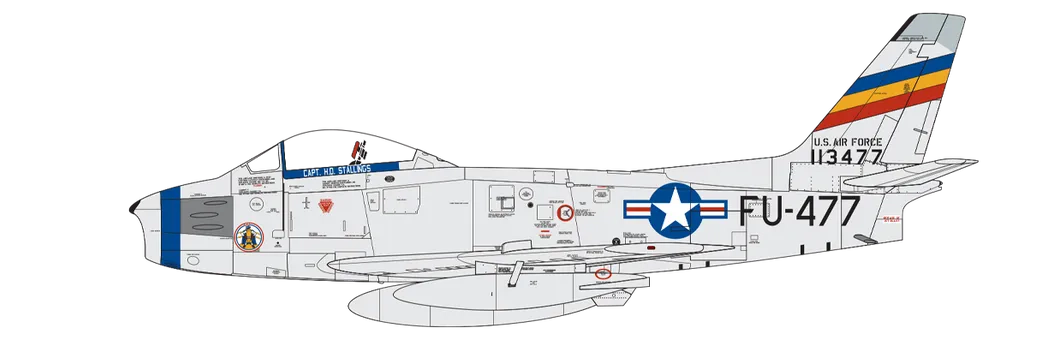
North American F-86F Sabre

North American F-86F Sabre
Airfix 1/48.
The North American F-86 Sabre, sometimes called the Sabrejet, is a transonic jet fighter aircraft. Produced by North American Aviation, the Sabre is best known as the United States' first swept-wing fighter that could counter the swept-wing Soviet MiG-15 in high-speed dogfights in the skies of the Korean War
(1950–1953), fighting some of the earliest jet-to-jet battles in
history. Considered one of the best and most important fighter aircraft
in that war, the F-86 is also rated highly in comparison with fighters
of other eras. Although it was developed in the late 1940s and was outdated by the end
of the 1950s, the Sabre proved versatile and adaptable and continued as
a front-line fighter in numerous air forces.
Its success led to an extended production run of more than 7,800
aircraft between 1949 and 1956, in the United States, Japan, and Italy.
In addition, 738 carrier-modified versions were purchased by the US Navy
as FJ-2s and -3s. Variants were built in Canada and Australia. The Canadair Sabre added another 1,815 aircraft and the significantly redesigned CAC Sabre (sometimes known as the Avon Sabre or CAC CA-27), had a production run of 112. The Sabre is by far the most-produced Western jet fighter, with a total production of all variants at 9,860 units.
- F-86F
- Uprated engine and larger "6–3" wing without leading-edge slats,
2,239 built; North American model NA-172 (F-86F-1 through F-15 blocks),
NA-176 (F-86F-20 and −25 blocks), NA-191 (F-86F-30 and -35 blocks),
NA-193 (F-86F-26 block), NA-202 (F-86F-35 block), NA-227 (first two
orders of F-86F-40 blocks comprising 280 aircraft that reverted to
leading-edge wing slats of an improved design), NA-231 (70 in third F-40
block order), NA-238 (110 in fourth F-40 block order), and NA-256 (120
in final F-40 block order); 300 additional aircraft in this series
assembled by Mitsubishi in Japan for Japanese Air Self-Defense Force.
Sabre Fs had much improved high-speed agility, coupled with a higher
landing speed of over 145 mph (233 km/h). The F-35 block had provisions
for a new operational role: the tactical nuclear attack
using newer, smaller, and lighter nuclear weapons ("second generation"
nuclear ordnance). The F-40 had a new slatted wing with a slightly
higher span, resulting in a slight decrease in speed, but also much
better agility at both high and low speeds and a reduced landing speed
of 124 mph (200 km/h). The USAF upgraded many previous F versions to the
F-40 standard. One E and two Fs were modified for improved performance
via rocket boost.
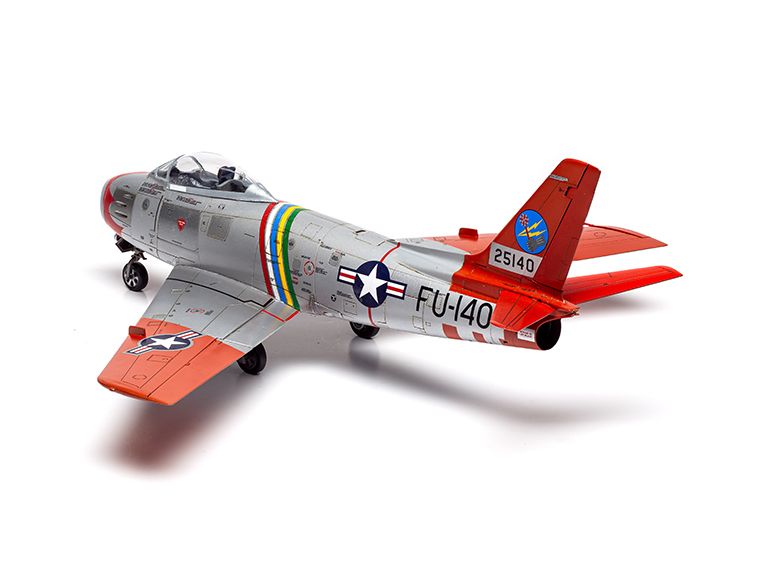
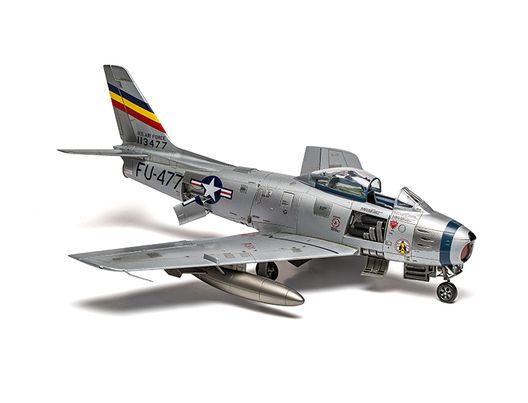


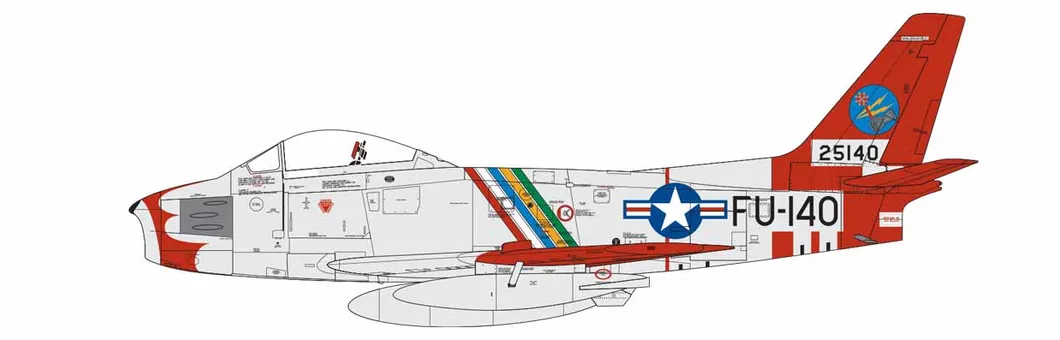
-
North American F-86F-30 Sabre, 'Arctic
Gladiators' aerobatic team, 720th Fighter-Bomber Squadron, United States
Air Force, Eielson Air Force Base, Alaska, 1955.