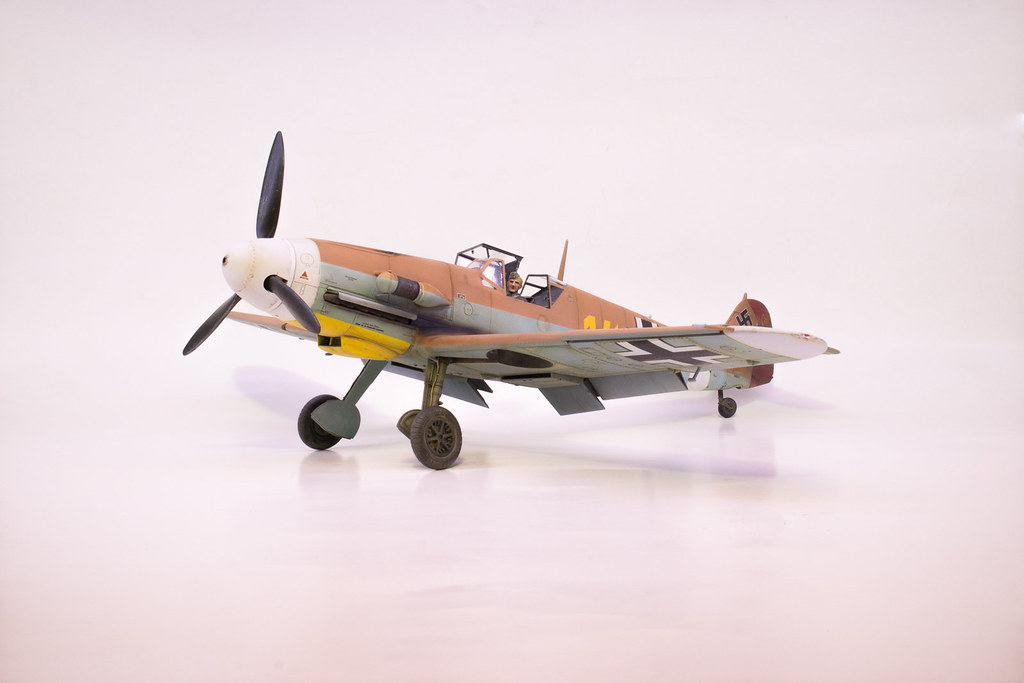
Messerschmitt Bf109F-4 Trop

Messerschmitt Bf109F-4 Trop
Palautuskäytäntö
Tavoitteenamme on, että jokainen asiakas on täysin tyytyväinen ostokseensa. Jos näin ei ole, kerro siitä meille, niin teemme parhaamme korjataksemme tilanteen.
Toimituskulut & toimitustavat
Toimituskulu 7,50€. Yli 130€ ostoskoreihin ilmainen toimitus.
Pyrimme lähettämään tilauksesi mahdollisimman nopeasti 1-3vrk arkipäivän kuluessa. Kun tilauksesi on lähetetty, saat sähköpostitse lisätietoja. Toimitusajat vaihtelevat sijaintisi mukaan.
Maksutavat
Käytössämme verkkokaupassa on yleisimmät maksutavat: debit- ja credit kortit, pankkimaksu, mobile pay, klarna. Maksunvälittäjänä toimii Paytrail.
Tuotetiedot
Valmistaja: Hasegawa
Mittakaava: 1:32
Hasegawa 1/32
Development of the new Bf 109 F airframe had begun in 1939. After February 1940, an improved engine, the Daimler-Benz DB 601E,
was developed for use with the Bf 109. The engineers at the
Messerschmitt facilities took two Bf 109 E-1 airframes and installed
this new powerplant. The first two prototypes, V21 (Werknummer (Works number) or W.Nr 5602) and V22 (W.Nr 1800) kept the trapeziform
wing shape from the E-1, but the span was reduced by 61 cm (2 ft) by
"clipping" the tips. Otherwise the wings incorporated the cooling system
modifications described below. V22 also became the testbed for the pre-production DB 601E. The smaller wings had a detrimental effect on the handling so V23, Stammkennzeichen (factory Code) CE+BP, W.Nr 5603, was fitted with new, semi-elliptical wingtips, becoming the standard wing planform for all future Bf 109 combat versions. The fourth prototype, V24VK+AB, W.Nr 5604, flew with the clipped wings but featured a modified, "elbow"-shaped supercharger air-intake, which was eventually adopted for production, and a deeper oil cooler bath beneath the cowling. On all of these prototypes, the fuselage was cleaned up and the engine cowling modified to improve aerodynamics.
From the F-4 onward, the new 20 mm Mauser MG 151/20 with 200 rounds was used as the Motorkanone. The first F-4s reached frontline units in June 1941. Production lasted
exactly a year between May 1941 and May 1942, with 1,841 of all F-4
variants produced. Some of the later models were capable of mounting two 20 mm MG 151/20
cannons under the wing in faired gondolas with 135 rpg. These were
designated F-4/R1 and 240 of them were produced by WNF in the first
quarter of 1942.This optional additional armament was standardized as field kit for later G and K series. A special high-altitude variant, the F-4/Z featuring GM-1 boost, was also built with a production run of 544 in the first quarter of 1942 and saw extensive use. Finally, the Erla factory produced 576 tropicalized F-4 trop in the first half of 1942.

With its initial engine rating of 1,200 PS, the maximum speed of the
F-4 (and F-3) was 635 km/h (394 mph) at rated altitude; and with the
clearance of the full rating of 1,350 PS, maximum speed increased to
659 km/h (410 mph) at 6,200 m (20,341 ft).
- F-4/R1 (capable of mounting two 20 mm MG 151/20 cannons in underwing gondolas)
- F-4/R2 (dedicated recon version, 5 built)
- F-4/R3 (dedicated recon version, 36 built)
- F-4/Z (As F-4, high-altitude fighter with GM-1 boost)
- F-4 trop (Tropicalized fighter)