Fiat G.50 2in1

Fiat G.50 2in1
Mark I Models 1:144
Fiat G.50 'Initial Series' (2in1 = 2 kits in 1 box) Italian AF, Finnish AF)
The Fiat G.50 was an Italian fighter aircraft designed in the mid-1930s, which became the most advanced fighter to be produced in Italy at that time. The prototype flew in February 1937, while the first production aircraft were delivered to the air force two years later.
In the autumn of 1940, an improved version with an extended combat range was introduced and designated the G.50bis. In total, production of the G.50 reached 784 aircraft in seven production series; 426 of which were manufactured by Fiat (Aeritalia) and another 358 were built by CMASA. 58 aircraft were exported: 13 G.50s to Spain, 35 aircraft to Finland and 10 went to Croatia.
It was a single-seat, all-metal low-wing monoplane featuring an open cockpit and a retractable undercarriage. It was powered by a Fiat A.74 two-row radial engine and was fitted with a Hamilton-Fiat propeller. The first versions of the G.50 were fitted with different configurations of armament: either a single or a pair of 12.7mm machine guns in the nose and an additional pair of 7.7mm guns in the wings. The Fiat G.50bis can be distinguished by the redesigned tail, addition of a larger rudder and relocated tail wheel.
The Fiat G.50s were extensively used on various fronts by Italy, including deployment in Belgium, North Africa, in the Balkans, in the Aegean and the Italian mainland. In Finland they served with distinction during the Winter War of 1940 and the Continuation War of 1941��½"44 against the Soviet Union.
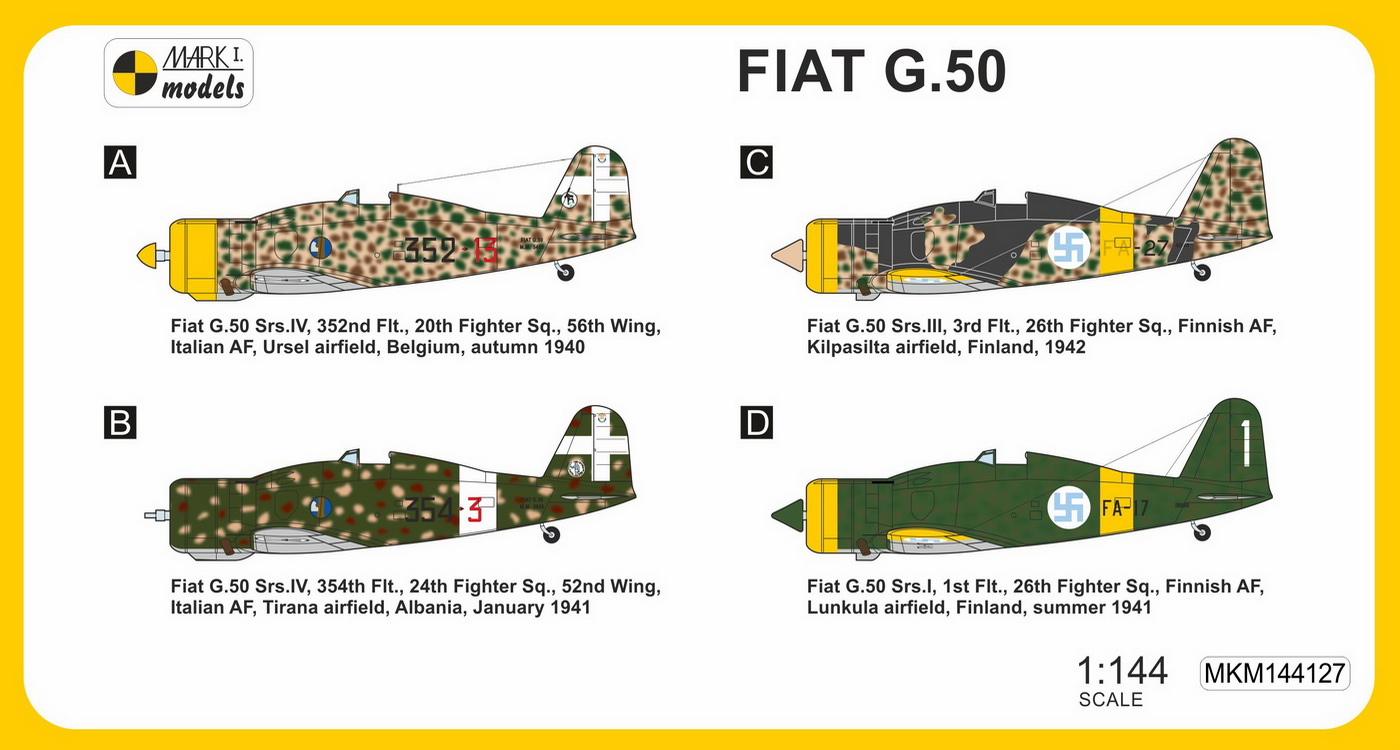
Colour schemes included in the kit:
1) Fiat G.50 Srs.IV (CMASA-built), Black 352-Red 13 (MM 5403), 352nd Flight (352a Squadriglia), 20th Fighter Squadron (20° Gruppo Caccia Terrestre, CT), 56th Wing (56° Stormo), Italian Air Corps (Corpo Aereo Italiano, CAI), Italian Air Force (Regia Aeronautica, RA), Ursel airfield, Belgium, autumn 1940
2) Fiat G.50 Srs.IV (CMASA-built), Black 354-Red 3 (MM unknown), 354th Flight (354a Squadriglia), 24th Fighter Squadron (24° Gruppo Caccia Terrestre, CT), 52nd Wing (52° Stormo), Italian Air Force (Regia Aeronautica, RA), Tirana airfield, Albania, January 1941
3) Fiat G.50 Srs.III (CMASA-built), FA-27 (MM 4944), Black FA-27, 3/LeLv 26 (3rd Fltight, 26th Fighter Squadron), Finnish Air Force (Ilmavoimat), Kilpasilta airfield, Finland, 1942
4) Fiat G.50 Srs.I (CMASA-built), FA-17 (MM 3599), Black FA-17/White 1, 1/LeLv 26 (1st Flight, 26th Fighter Squadron), Finnish Air Force (Ilmavoimat), Lunkula airfield, Finland, summer 1941
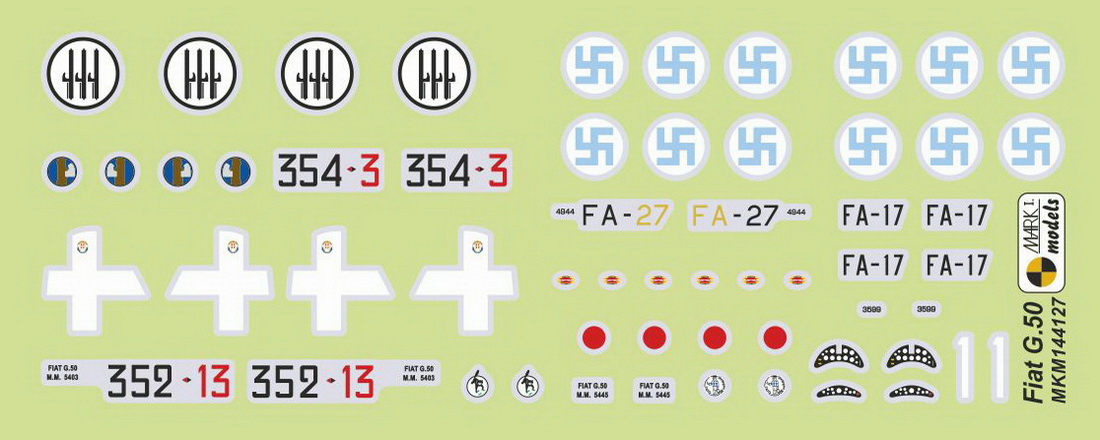
Two injection-moulded kits are supplied in this box and each kit contains 38 parts and one clear part (the cockpit windshield). A comprehensive decal sheet is included.
Suomalainen Fiat G.50
The Fiat G.50 Freccia (“Arrow”) was a World War II Italian fighter aircraft that was developed and manufactured by the aviation company Fiat. Upon entering service, the type became Italy's first single-seat, all-metal monoplane that had an enclosed cockpit and retractable undercarriage. On 26 February 1937, the G.50 conducted its maiden flight. During early 1938, the Freccias served in the Regia Aeronautica (the Italian Air Force) and with its expeditionary arm, the Aviazione Legionaria, in Spain, where they compared well in speed and manoeuvrability with their adversaries in the theatre.
The fighter was extensively used on various fronts by Italy, including in Northern Europe, North Africa, the Balkans, and the Italian mainland. The G.50 commonly came up against the British Hawker Hurricane,
which was fast enough to frequently outrun the Italian opponent, and
could also outrange it. In addition, early in the Second World War it
became apparent that the G.50 possessed inadequate armament, comprising a
pair of Breda-SAFAT12.7-mmmachine guns.
Later models of the fighter incorporated improvements, including an
increase in fuel capacity that gave rise to a substantial increase in
range
The G.50 saw its longest and most successful service in the two Finnish wars against the Soviet Union, the Winter War of 1939–1940 and the Continuation War
of 1941–1944. At the end of 1939, before the outbreak of hostilities,
Finland ordered 35 Fiat G.50s. The first 10 aircraft were to be
delivered before February 1940. A group of Finnish pilots attended a
10-hour training course at Guidonia airport and later at Fiat Aviazione
in Turin. On a training flight, during a dive from 3,500 m (11,500 ft),
Lieutenant Tapani Harmaja reached an estimated speed of 780 km/h
(480 mph), which was considered excessive for the structural integrity
of the aircraft. The windscreen was damaged