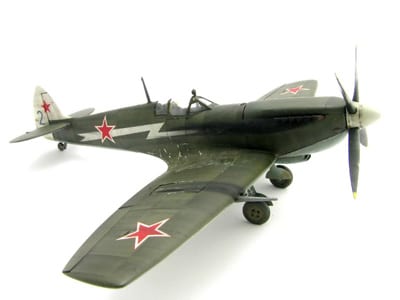
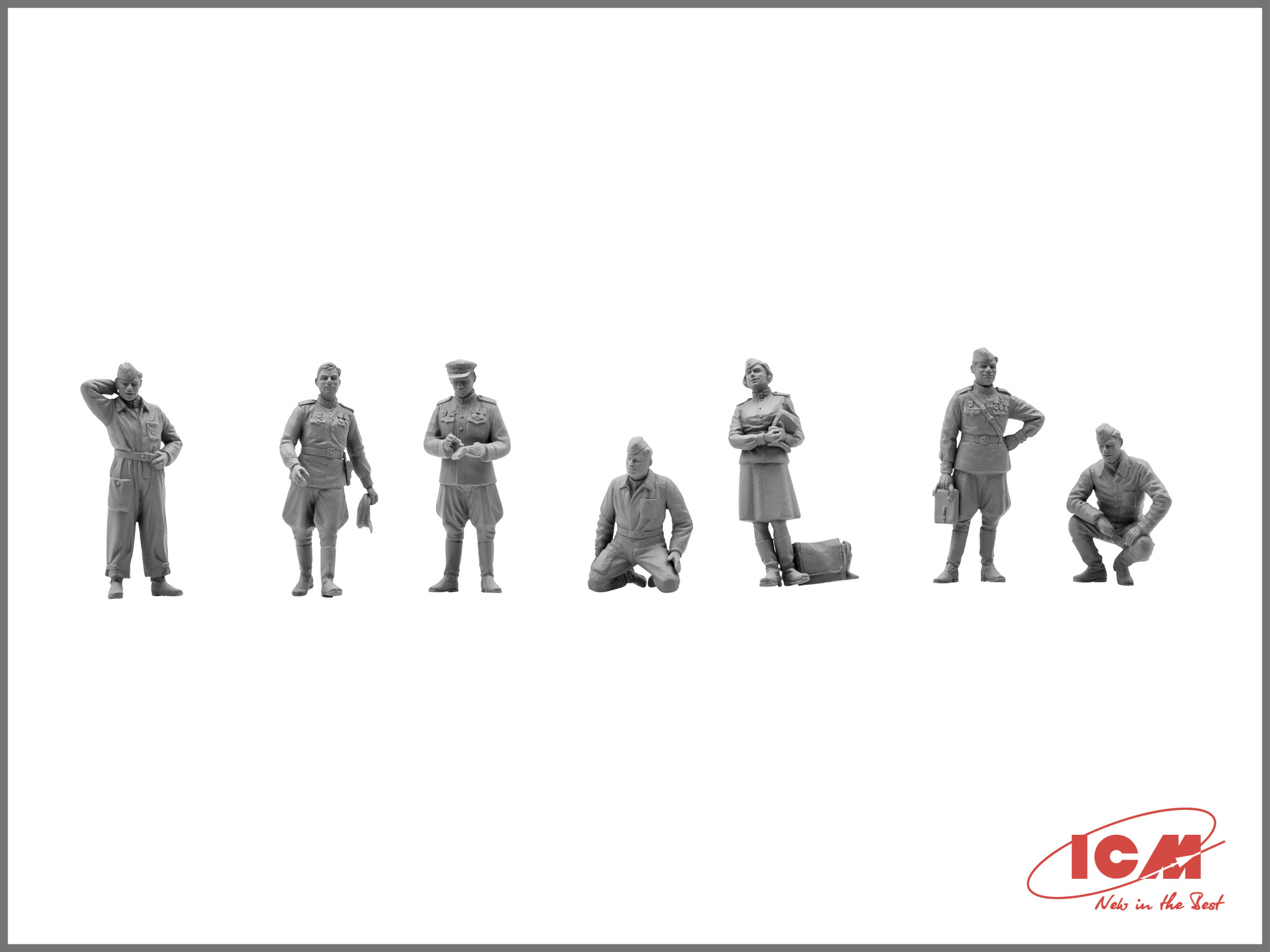
Spitfire LF.IXe with Soviet Pilots & Ground Personnel

Spitfire LF.IXe with Soviet Pilots & Ground Personnel
ICM 1/48
The Supermarine Spitfire is a British single-seat fighter aircraft that was used by the Royal Air Force and other Allied countries before, during, and after World War II.
It was the only British fighter produced continuously throughout the
war. The Spitfire remains popular among enthusiasts. Around 70 remain airworthy, and many more are static exhibits in aviation museums throughout the world.
The Spitfire was a short-range, high-performance interceptor aircraft designed by R. J. Mitchell, chief designer at Supermarine Aviation Works, which operated as a subsidiary of Vickers-Armstrong from 1928. Mitchell modified the Spitfire's distinctive elliptical wing (designed by Beverley Shenstone)
with innovative sunken rivets to have the thinnest possible
cross-section, achieving a potential top speed greater than that of
several contemporary fighter aircraft, including the Hawker Hurricane. Mitchell continued to refine the design until his death in 1937, whereupon his colleague Joseph Smith took over as chief designer.
-
IX
Although the Mk IX's airframe did not have the aerodynamic and strength
improvements, or the modified control surfaces of the Mk VII and VIII,
the Mk IX still proved to be an effective counter to the Focke-Wulf Fw
190.In September 1942, the "High Altitude Flight" was set up at RAF Northolt to counter the threat of the high altitude Junkers Ju 86 R
bombers. Two Spitfire Mk IXs converted from Vcs were stripped of
armour, the .303 Brownings and other equipment and repainted in a
lightweight PRU blue finish. One of them intercepted a Ju 86R at over 40,000 feet (12,000 m).Production of the Mk IX finished at Supermarine in June 1943,
with production continuing exclusively at the Castle Bromwich factory.
Several major and large numbers of minor improvements were progressively
introduced to Mk IXs, some of which were used on other Spitfire
variants.Production of the LF Mk IXs, frequently referred to as the Spitfire Mk
IXb, initially ran in parallel with the Merlin 63 powered Marks. This
version first became operational in March 1943 with the Biggin Hill Wing, comprised at the time of 611 and 341 (Free French)
Squadrons. This type was by far the most produced of the Spitfire Mk IX
variants, with over 4,000 built. The maximum power of the Merlin 66 was
1,720 hp (1,280 kW) at 5,750 ft (1,283 kW at 1,752 m) and the maximum
speed of the Spitfire LF Mk IX was 404 mph (650 km/h) at 21,000 feet
(6,400 m).[34] The Merlin 66 introduced a new Bendix-Stromberg injection carburettor, which replaced the earlier S.U float carburettor.E type
Structurally identical to the C wing. The outer machine gun ports
were eliminated; although the outer machine-gun bays were retained,
their access doors were devoid of empty cartridge case ports and
cartridge deflectors. The new wing allowed for a four cannon armament
and the inner bays could carry heavy machine guns. There were thus two possible weapon fits:
either - 2 × .50 calBrowning M2 machine guns with 250 rpg in the inner bays and 2 × 20 mm Hispano Mk II cannon with 120 rpg in the outer bays
- 4 × 20 mm Hispano cannon with 120 rpg
or
The .303 machine guns mounted in the outer wings were no longer
fitted, because rifle calibre bullets were ineffective against heavily
armoured aircraft. (These outer guns had always been the less effective
part of a Spitfire's armament: their distance from the centreline made
them hard to harmonise
and in turning engagements, wing flexing meant that the rounds were
even more widely scattered). The 20 mm Hispano cannon were moved
outboard and the .50 calibre Browning M2/AN, with 250 rpg were added to
the inner gun-bays. The first trial installation (modification 1029) was
made in BS118 in November 1943; by mid-March 1944 the first
service Spitfires to be modified were from 485 (NZ), 222 and 349
Squadrons. Spitfires with this armament were at first referred to as Spifire LF.IX .5
and the E suffix was not officially introduced until early 1945. This
armament was standard for all Spitfire Mk IXs and XVIs used by the 2nd
Tactical Air Force as fighters and fighter-bombers from shortly after D-Day. It proved more effective for both air-to-air engagements and air-to-ground attacks.[9]
Many Spitfires had their elliptically "pointed" wing tips
replaced by shorter, squared off fairings. This slightly improved
maximum speed at low altitude and enhanced the roll rate. While many
"LF" Spitfires (e.g. the LF.IX) had the "clipped" wings, a number
did not. The true distinguishing feature of "LF" versions was the
fitting of low-altitude versions of the Rolls-Royce Merlin engine.