

Japanese Light Cruiser Abukuma
€30,00 EUR
Siirry tuotetietoihin

1 jäljellä
1/700 SCALE JAPANESE LIGHT CRUISER ABUKUMA

Japanese Light Cruiser Abukuma
€30,00 EUR
1/700 Water Line Series
1/700 SCALE JAPANESE LIGHT CRUISER ABUKUMA
Length: 230
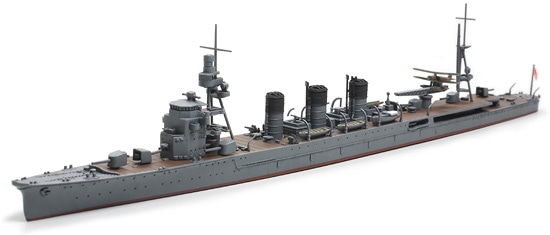
mm. Image shows painted and assembled kit.
A Pearl Harbor Escort
The Abukuma was a smartly designed 5500 ton light cruiser completed in
1925 as the sixth ship of the Nagara class. Armed with seven 14cm guns
and four dual 61cm torpedo launchers and with a top speed of 36 knots,
she had significant offensive capabilities. During a training exercise
in October 1930, the Abukuma lost its bow, so it became the only ship in
the Nagara-class to have the high double curved bow for better
seaworthiness. While undergoing modernization, the Abukuma was fitted
with powerful two quadruple 61cm torpedo launchers. During the Pacific
War, it served as the flagship for the 1st Destroyer Squadron and as an
escort for the Pearl Harbor attack force. She also took part in "the
miraculous operation," the withdrawal from Kiska. Abukuma's luck ran out
in October 1944, when she met her final fate at the Battle of Leyte
Gulf.
Abukuma Specifications
●Displacement: 5,170 tons (At time of construction) ●Length: 162.15m,
Width: 14.17m ●Propulsion:4 steam turbines. ●Speed:36 knots ●Armament:
14cm guns x7, quadruple 61cm torpedo launchers x2
About the Model
This is a 1/700 scale plastic assembly kit of the Japanese Light Cruiser
Abukuma. ★Length 230mm. Classic design with long, narrow hull and 3
funnels accurately reproduced. ★The hull divides into left and right
parts. The Abukuma was the only ship with a double curved bow in the
Nagara-class. The ship's fine details like the telegram lines are
realistically reproduced. ★Model depicts the ship as she appeared at the
time of Pearl Harbor, with quadruple torpedo launchers, seven 14cm
guns, various anti-aircraft equipment, and a uniquely shaped
shelter-style deck. ★The 140mm guns and catapult can turn freely. ★It
would be interesting to compare the Abukuma to other 5,500 ton light
cruisers in the Kuma-class and Nagara-class.
The Abukuma was a smartly designed 5500 ton light cruiser completed in
1925 as the sixth ship of the Nagara class. Armed with seven 14cm guns
and four dual 61cm torpedo launchers and with a top speed of 36 knots,
she had significant offensive capabilities. During a training exercise
in October 1930, the Abukuma lost its bow, so it became the only ship in
the Nagara-class to have the high double curved bow for better
seaworthiness. While undergoing modernization, the Abukuma was fitted
with powerful two quadruple 61cm torpedo launchers. During the Pacific
War, it served as the flagship for the 1st Destroyer Squadron and as an
escort for the Pearl Harbor attack force. She also took part in "the
miraculous operation," the withdrawal from Kiska. Abukuma's luck ran out
in October 1944, when she met her final fate at the Battle of Leyte
Gulf.
Abukuma Specifications
●Displacement: 5,170 tons (At time of construction) ●Length: 162.15m,
Width: 14.17m ●Propulsion:4 steam turbines. ●Speed:36 knots ●Armament:
14cm guns x7, quadruple 61cm torpedo launchers x2
About the Model
This is a 1/700 scale plastic assembly kit of the Japanese Light Cruiser
Abukuma. ★Length 230mm. Classic design with long, narrow hull and 3
funnels accurately reproduced. ★The hull divides into left and right
parts. The Abukuma was the only ship with a double curved bow in the
Nagara-class. The ship's fine details like the telegram lines are
realistically reproduced. ★Model depicts the ship as she appeared at the
time of Pearl Harbor, with quadruple torpedo launchers, seven 14cm
guns, various anti-aircraft equipment, and a uniquely shaped
shelter-style deck. ★The 140mm guns and catapult can turn freely. ★It
would be interesting to compare the Abukuma to other 5,500 ton light
cruisers in the Kuma-class and Nagara-class.
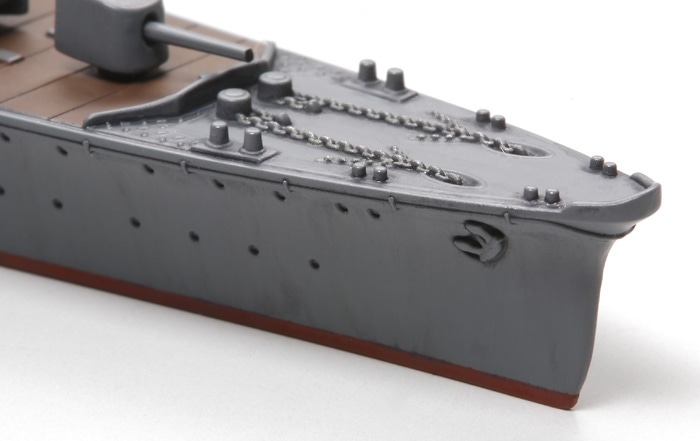
■The double curve shape and soft lines are accurately reproduced.
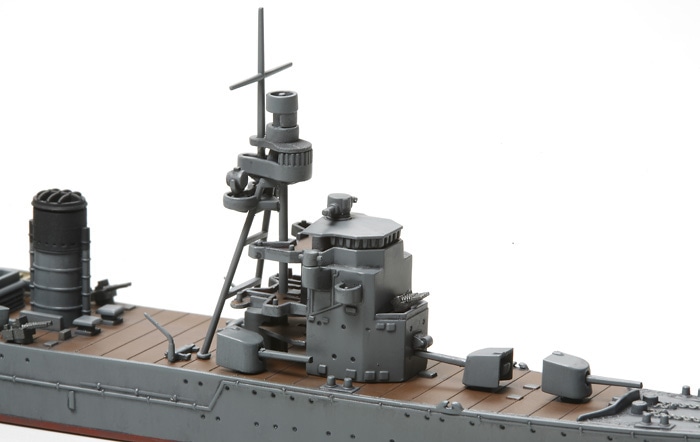
■The compact shape of the bridge deck, the tripod mast, and the 14cm guns all have a sharp finish.
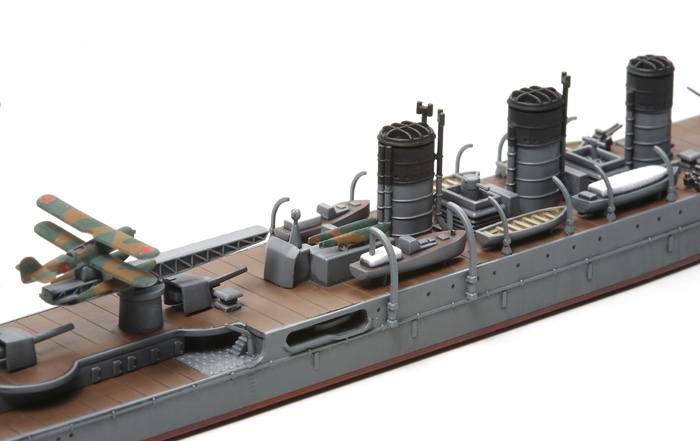
■Here you can see quadruple torpedo launchers, the unique shelter-style deck, and the upright funnels.