
ALE
The General Dynamics F-111 Aardvark is a retired American supersonic, medium-range interdictor and tactical attack aircraft that also filled the roles of strategic nuclear bomber, aerial reconnaissance, and electronic-warfare aircraft in its various versions. The word "aardvark" is Afrikaans for "earth pig" and reflects the look of the long nose of the aircraft that might remind one of the nose of the aardvark. Developed in the 1960s by General Dynamics, it entered service in 1967 with the United States Air Force (USAF). The Royal Australian Air Force (RAAF) also ordered the type and began operating F-111Cs in 1973.
The F-111 pioneered several technologies for production aircraft, including variable-sweep wings, afterburning turbofan engines, and automated terrain-following radar for low-level, high-speed flight. Its design influenced later variable-sweep wing aircraft, and some of its advanced features have since become commonplace. The F-111 suffered a variety of problems during initial development. Several of its intended roles, such as an aircraft carrier-based naval interceptor with the F-111B, failed to materialize.
USAF F-111s were retired during the 1990s with the F-111Fs in 1996 and EF-111s in 1998. The F-111 was replaced in USAF service by the F-15E Strike Eagle for medium-range precision strike missions, while the supersonic bomber role has been assumed by the B-1B Lancer. The RAAF was the last operator of the F-111, with its aircraft serving until December 2010.
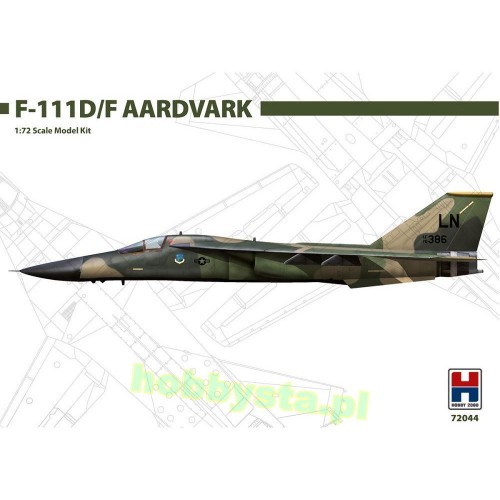
F-111D
The F-111D was an upgraded F-111A equipped with newer Mark II avionics, more powerful engines, improved intake geometry, and an early glass cockpit. The variant was first ordered in 1967 and delivered from 1970–73. The F-111D reached initial operational capability in 1972. Deliveries were delayed due to avionics issues. 96 F-111Ds were built. The sole operator of this variant was the 27th TFW stationed at Cannon AFB, New Mexico.
The F-111D used the new Triple Plow II intakes, which were located four inches (100 mm) further away from the airframe to prevent engine ingestion of the sluggish boundary layer air that was known to cause stalls in the TF30 turbofans. It had more powerful TF30-P-9 engines with 12,000 lbf (53 kN) dry and 18,500 lbf (82 kN) afterburning thrust.
The Mark II avionics were digitally integrated microprocessor systems, some of the first used by the USAF, offering tremendous capability, but substantial problems. The Rockwell Autonetics digital bombing-navigation system included inertial navigation system, AN/APQ-130 attack radar system and Doppler radar. It also included digital computer set and multi-function displays (MFDs). The terrain-following radar was the Sperry AN/APQ-128. The attack radar featured a Doppler beam-sharpening, moving target indication (MTI), and Continuous-wave radar for guiding semi-active radar homing missiles.
It took years to improve the reliability of the avionics, but issues were never fully addressed.[45][102] According to Crandall, "The truth is that the D model didn't work. They parked every single one of them in Fort Worth for several years as they worked to fix the bugs". The F-111D was withdrawn from service in 1991 and 1992
F-111F
Crandall described the F-111F as "the Cadillac of the F-111 force". It was the final variant produced for Tactical Air Command, with a modern, but less expensive, Mark IIB avionics system.[111] The USAF approved development of the variant in 1969. It also included the more powerful TF30-P-100 engine and strengthened wing carry-through box. 106 were produced between 1970 and 1976.
The F-111F's Mark IIB avionics suite used a simplified version of the FB-111A's radar, the AN/APQ-144, lacking some of the strategic bomber's operating modes but adding a new 2.5 mi (4.0 km) display ring. Although it was tested with digital moving-target indicator (MTI) capacity, it was not used in production sets.[111] The Mark IIB avionics combined some Mark II components with FB-111A components, such as the AN/APQ-146 terrain-following radar. The F-111E's weapon management system was also included.
Crandall stated that the F-111F was almost capable of supercruise, and could reach Mach 1.4 at sea level on full afterburner. It used the Triple Plow II intakes, along with the substantially more powerful TF30-P-100 turbofan with 25,100 lbf (112 kN) afterburning thrust, 35% more thrust than the F-111A and E. An adjustable engine nozzle was added to decrease drag. The P-100 engine greatly improved the F-111F's performance. The engines were upgraded to the TF30-P-109 version, later in the 1985–86 timeframe.
In the early 1980s, the F-111F began to be equipped with the AVQ-26 Pave Tack forward looking infrared (FLIR) and laser designator system, which provided for the delivery of precision laser-guided munitions and was mounted in the internal weapons bay. The Pacer Strike avionics update program replaced analog equipment with new digital equipment and multi-function displays. The last USAF F-111s were withdrawn from service in 1996, replaced by the McDonnell Douglas F-15E Strike Eagle