
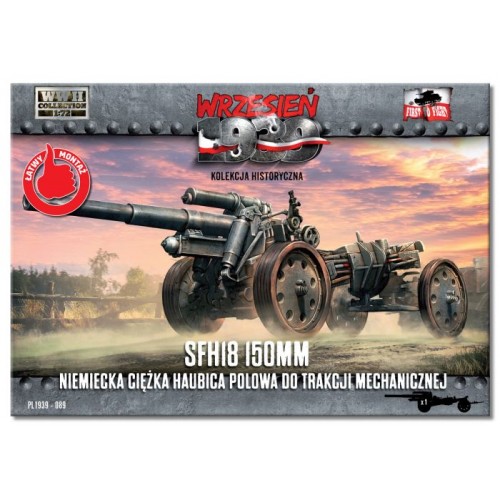
First to fight 1/72
The 15 cm schwere Feldhaubitze 18 or sFH 18 (German: "heavy field howitzer, model 18"), nicknamed Immergrün ("Evergreen"), was the basic German division-level heavy howitzer of 149 mm (5.9 in) during the Second World War, serving alongside the smaller but more numerous 10.5 cm leFH 18. Its mobility and firing range and the effectiveness of its 44 kg (97 lb) shell made it the most important weapon of all German infantry divisions. A total of 6,756 examples were produced.
It replaced the earlier, First World War-era design of the 15 cm sFH 13, which was judged by the Krupp-Rheinmetall designer team of the sFH 18 as completely inadequate. The sFH 18 was twice as heavy as its predecessor, had a muzzle velocity increase of forty percent, a maximum firing range 4.5 km (2.8 mi) greater, and a new split-trail gun carriage that increased the firing traverse twelvefold. The secret development from 1926 to 1930 allowed German industry to deliver a trouble-free design at the beginning of German re-armament in 1933. It was the first artillery weapon equipped with rocket-assisted ammunition to increase range. The sFH 18 was also used in the self-propelled artillery piece schwere Panzerhaubitze 18/1 (more commonly known as Hummel).
