
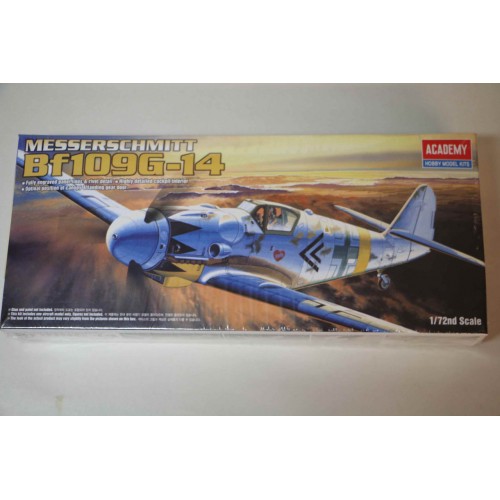
Academy 1/72
TThe G-14 arrived in July 1944 at the invasion front over France. It represented an attempt to create a standard type, incorporating many changes which had been introduced during production of the G-6, and which led to a plethora of variants, plaguing decentralized mass production. The standardization attempt proved to be a failure, but overall the type offered improved combat performance, as MW 50 power boosting water injection (increasing output to 1,800 PS (1,775 hp, 1,324 kW), the clear-view Erla Haube was now standard installation. Top speed was 573 km/h (353 mph) at sea level, and 665 km/h (413 mph) at 5 km (16,400 ft) altitude. A high-altitude fighter, designated G-14/AS was also produced with the DB 605ASM high-altitude engine. The ASM engine was built with a larger capacity supercharger, and had a higher rated altitude, and correspondingly the top speed of the G-14/AS was 590 km/h (348 mph) at sea level, and 680 km/h (422 mph) at 7.5 km (24,600 ft) altitude.
There was increasing tendency to use plywood on some less vital parts e.g. on a taller fin/rudder unit, pilot seat or instrument panel. A cautious estimate based on the available records suggest that about 5,500 G-14s and G-14/AS were built.
The following variants of the G-14 were produced:
- G-14 (Fighter; standardized late-production G-6; DB 605AM engine, MW 50 boost)
- G-14/AS (High-altitude fighter with DB 605ASM engine, MW 50 boost)
- G-14/ASy (High-altitude command fighter)
- G-14y (command fighter)
- G-14/U4 (As G-14, but with 30 mm/1.18 in MK 108 Motorkanone-engine gun)


