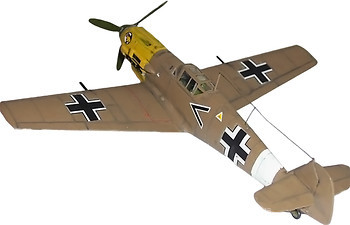
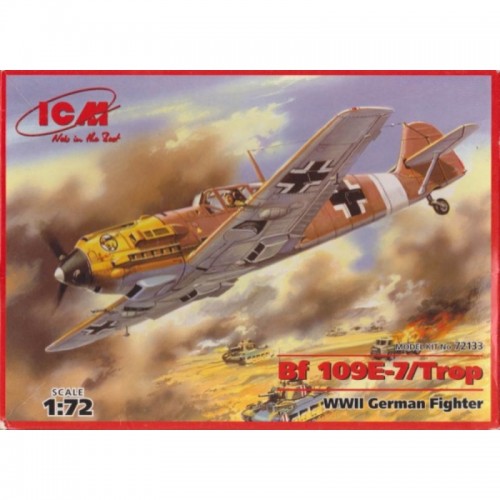
ICM 1/72
The Messerschmitt Bf 109 is a monoplane fighter aircraft that was designed and initially produced by the German aircraft manufacturer Bayerische Flugzeugwerke (BFW). Together with the Focke-Wulf Fw 190, the Bf 109 formed the backbone of the Luftwaffe's fighter force during the Second World War. It was commonly called the Me 109 by Allied aircrew and some German aces/pilots, even though this was not the official model designation.
The Bf 109 was designed by Willy Messerschmitt and Robert Lusser, who worked at BFW during the early to mid-1930s. It was conceived as an interceptor. However, later models were developed to fulfill multiple tasks, serving as bomber escort, fighter-bomber, day-, night-, all-weather fighter, ground-attack aircraft, and aerial reconnaissance aircraft. It was one of the most advanced fighters when the fighter first appeared, being furnished with an all-metal monocoque construction, a closed canopy, retractable landing gear, and powered by a liquid-cooled, inverted-V12 aero engine. First flown on 29 May 1935, the Bf 109 entered operational service during 1937; it first saw combat during the Spanish Civil War.
E-7
The E-7 was the next major production variant, entering service and seeing combat at the end of August 1940. One of the limitations of the earlier Bf 109Es was their short range of
660 km (410 mi) and limited endurance, as the design was originally
conceived as a short-range interceptor. The E-7 rectified this problem as it was the first Bf 109 subtype to be able to carry a drop tank,
usually the standardized Luftwaffe 300 L (80 US gal) capacity unit
mounted on a centre-line rack under the fuselage, which increased its
range to 1,325 km (820 mi). Fuel from the drop tank was pumped to the
internal fuel tank via a large fuel line that ran up and along the
inside starboard wall of the cockpit, with a clear sight glass located
in the fuel line's main span so the pilot could easily see the flow of
fuel and know when the tank was empty. Alternatively, a bomb could be
fitted and the E-7 could be used as a Jabo fighter-bomber.
Previous Emil subtypes were progressively retrofitted with the necessary
fittings for carrying a drop tank from October 1940. Early E-7s were fitted with the 1,100 PS DB 601A or 1,175 PS DB 601Aa
engine, while late-production ones received 1,175 PS DB 601N engines
with improved altitude performance – the latter was designated as E-7/N. A total of 438 E-7s of all variants were built