
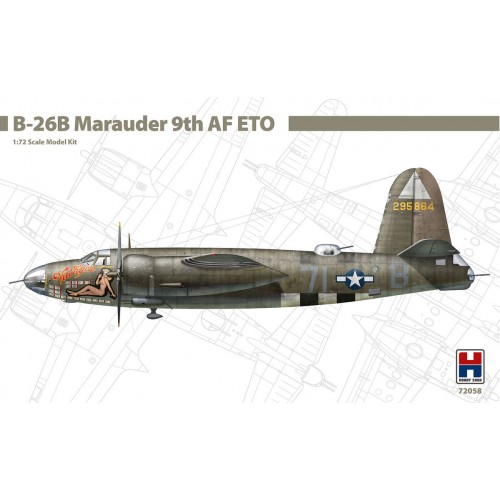
Hobby 2000 1/72
The Martin B-26 Marauder is an American twin-engined medium bomber that saw extensive service during World War II. The B-26 was built at two locations: Baltimore, Maryland, and Omaha, Nebraska, by the Glenn L. Martin Company.
First used in the Pacific Theater of World War II in early 1942, it was also used in the Mediterranean Theater and in Western Europe.
After entering service with the United States Army aviation units, the aircraft quickly received the reputation of a "widowmaker" due to the early models' high accident rate during takeoffs and landings. This was because the Marauder had to be flown at precise airspeeds, particularly on final runway approach or when one engine was out. The unusually high 150 mph (241 km/h) speed on short final runway approach was intimidating to many pilots who were used to much slower approach speeds, and when they slowed to speeds below those stipulated in the manual, the aircraft would often stall and crash.
B-26B — This model had further improvements on the B-26A, including revised tail gunner's glazing. Nineteen were delivered to the Royal Air Force as the Marauder Mk.IA. Production blocks of the 1,883 aircraft built:
- AT-23A or TB-26B—208 B-26Bs converted into target tugs and gunnery trainers designated JM-1 by the US Navy
- B-26B—Single tail gun replaced with twin guns; belly-mounted "tunnel gun" added (81 built)
- B-26B-1—Improved B-26B. (225 built)
- B-26B-2—Pratt & Whitney R-2800-41 radials (96 built)
- B-26B-3—Larger carburetor intakes; upgrade to R-2800-43 radials (28 built)
- B-26B-4—Improved B-26B-3 (211 built)
- B-26B-10 through B-26B-55 — Beginning with block 10, the wingspan was increased from 65 to 71 feet (20 to 22 m) and flaps were added outboard of the engine nacelle to improve handling problems during landing caused by high wing loads. The vertical stabilizer height was increased from 19 feet 10 inches (6.05 m) to 21 feet 6 inches (6.55 m). Armament was increased from six to twelve .50 caliber machine guns; this was done in the forward section so that the B-26 could perform strafing missions. The tail gun was upgraded from manual to power operated. Armor was added to protect the pilot and copilot; 1,242 were built.
- CB-26B—12 B-26Bs were converted into transport aircraft (all were delivered to the US Marine Corps for use in the Philippines)
