
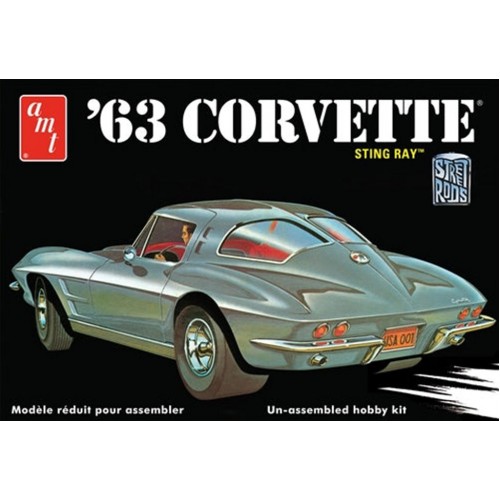
AMT 1/25
The Chevrolet Corvette is a line of American two-door, two-seater sports cars manufactured and marketed by General Motors under the Chevrolet marque since 1953.
Throughout eight generations, indicated sequentially as C1 to C8, the Corvette is noted for its performance, distinctive styling, lightweight fiberglass or composite bodywork, and competitive pricing. The Corvette has had domestic mass-produced two-seater competitors fielded by American Motors, Ford, and Chrysler; it is the only one continuously produced by a United States auto manufacturer. It serves as Chevrolet's halo car
Second generation (C2; 1963–1967
The second generation (C2) Corvette, which introduced Sting Ray to the model, continued with fiberglass body panels, and overall, was smaller than the first generation. The car was designed by Larry Shinoda with major inspiration from a previous concept design called the "Q Corvette," which was created by Peter Brock and Chuck Pohlmann under the styling direction of Bill Mitchell. Earlier, Mitchell had sponsored a car known as the "Mitchell Sting Ray" in 1959 because Chevrolet no longer participated in factory racing. This vehicle had the largest effect on the styling of this generation, although it had no top and did not give away what the final version of the C2 would look like. The third inspiration was a mako shark Mitchell had caught while deep-sea fishing.
Four-wheel disc brakes were introduced in 1965, as was a "big block" engine option: the 396 cu in (6.49 L) V8. Side exhaust pipes were also optionally available in 1965, and continued to be offered through 1967. The introduction of the 425 hp (317 kW; 431 PS) 396 cu in (6.49 L) big block in 1965 spelled the beginning of the end for the Rochester fuel injection system. The 396 cu in (6.49 L) option cost US$292.70 while the fuel injected 327 cu in (5.36 L) engine cost US$538.00. Few could justify spending US$245.00 more for 50 hp (37 kW; 51 PS) less, even though FI could deliver over 20 mpg on the highway and would keep delivering fuel despite high G-loading in corners taken at racing speeds. Another 1963 and 1964 option was the Z06 competition package, which offered stiffer suspension, bigger, multi-segment lined brakes with finned drums, and more. Only a couple hundred coupes and a single convertible were factory-equipped this way in 1963. With only 771 fuel-injected cars built in 1965, Chevrolet discontinued the option at the end of the 1965 production, having introduced a less-expensive big block 396 engine rated at 425 hp in the middle of the production year and selling over 2,000 in just a few months. For 1966, Chevrolet introduced an even larger 427 cu in (7.00 L) Big Block version. Other options available on the C2 included the Wonderbar auto-tuning AM radio, AM-FM radio (mid-1963), air conditioning (late-1963), a telescopic steering wheel (1965), and headrests (1966). The Sting Ray's independent rear suspension was successfully adapted for the new-for-1965 Chevrolet Corvair, which solved the quirky handling problems of that unique rear-engine compac
