
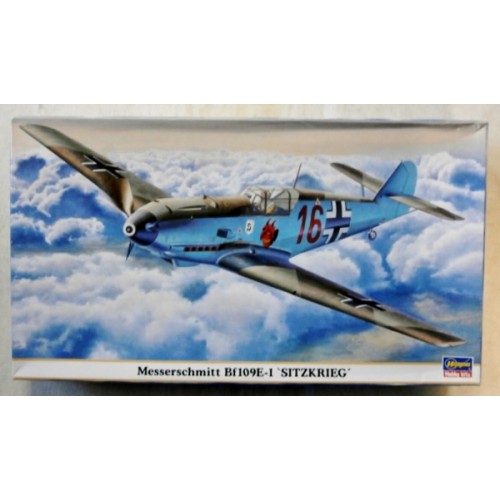
Hasegawa 1/48
The Messerschmitt Bf 109 is a German World War II fighter aircraft that was, along with the Focke-Wulf Fw 190, the backbone of the Luftwaffe's fighter force. The Bf 109 first saw operational service in 1937 during the Spanish Civil War. It was still in service at the end of World War II in 1945.[3] It was one of the most advanced fighters when it first appeared, with an all-metal monocoque construction, a closed canopy, and retractable landing gear. A liquid-cooled, inverted-V12 aero engine powered it. It was called the Me 109 by Allied aircrew and some German aces, even though this was not the official German designation.
E-1
The E-1 production version kept two 7.92 mm (.312 in) MG 17s
above the engine and two more in the wings. Later, many were modified to
the E-3 armament standard. The E-1B was a small batch of E-1s that became the first operational Bf 109 fighter bomber, or Jagdbomber (usually abbreviated to Jabo).
These were fitted with an ETC 500 bomb rack, carrying either one 250 kg
(550 lb) bomb or four 50 kg (110 lb) bombs. The E-1 was also fitted
with the Reflexvisier "Revi" gunsight. Communications equipment was the
FuG 7 Funkgerät 7 (radio set) short-range radio apparatus,
effective to ranges of 48–56 km (30–35 mi). A total of 1,183 E-1 were
built, 110 of them were E-1/B
- E-1/B (Fighter-bomber version of E-1, usually with DB 601Aa)
