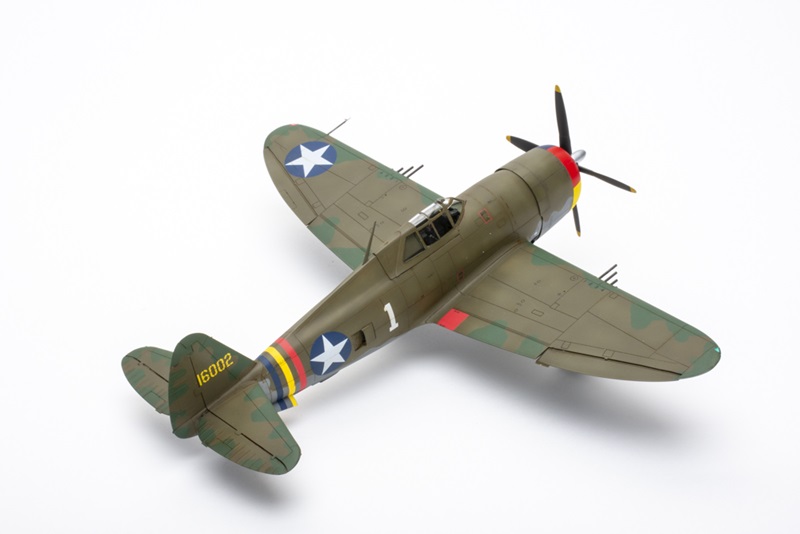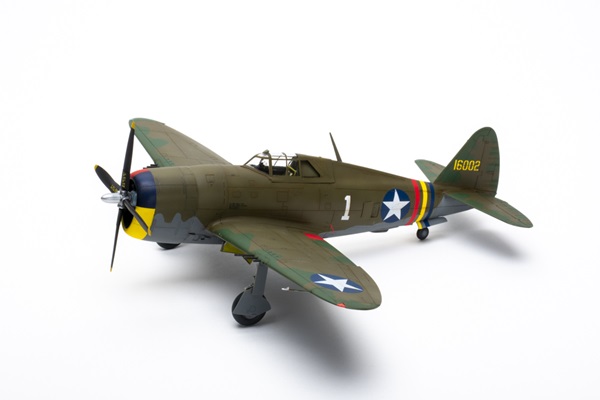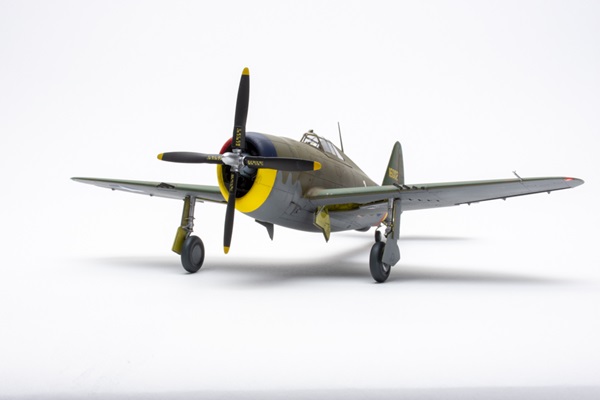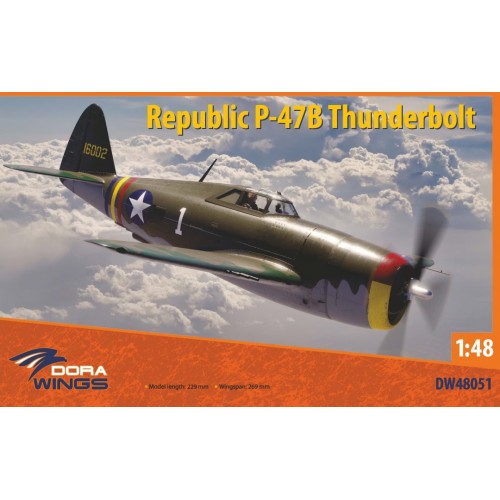
Dora Wings 1/48
The Republic P-47 Thunderbolt is a World War II-era fighter aircraft produced by the American company Republic Aviation from 1941 through 1945. It was a successful high-altitude fighter, and it also served as the foremost American fighter-bomber in the ground-attack role. Its primary armament was eight .50-caliber machine guns, and it could carry 5-inch rockets or a bomb load of 2,500 lb (1,100 kg). When fully loaded, the P-47 weighed up to 8 tons, making it one of the heaviest fighters of the war.
The Thunderbolt was effective as a short- to medium-range escort fighter in high-altitude air-to-air combat and ground attack in both the European and Pacific theaters. The P-47 was designed around the powerful Pratt & Whitney R-2800 Double Wasp 18-cylinder radial engine, which also powered two U.S. Navy/U.S. Marine Corps fighters, the Grumman F6F Hellcat and the Vought F4U Corsair. An advanced turbosupercharger system ensured the aircraft's eventual dominance at high altitudes, while also influencing its size and design.
P-47B
On June 12, 1940, Kartveli submitted the redesigned AP-10 to the
USAAC. The new aircraft was much larger than the original, and the
inline engine was swapped for a turbo-supercharged Pratt & Whitney R-2800 Double Wasp 18-cylinder radial engine. Armament was increased to eight M2 Brownings, four mounted in each
wing, making it one of the heaviest-armed fighters considered by the
USAAC at the time. The expected performance met USAAC requirements, however, its fuel load fell slightly short. Despite this, the USAAC ordered a prototype of the improved design as the XP-47B, on September 6, 1940.
The XP-47B was first flown on May 6, 1941. It was powered by a 1,960 hp XR-2800-21 engine and featured an elliptical wing, an all-metal construction (except for the fabric-covered control surfaces), and a hinged canopy. The main landing gear retracted inward into the wings, telescoping
nine inches to clear the underside of the fuselage, and the steerable
tailwheel was fully retractable. With a loaded weight of 12,086 lb, the
XP-47B was almost twice as heavy as its competitors. Performance was
higher than expected with a maximum speed of 412 mph.[1]
The XP-47B crashed on August 8, 1942, however, an order for 773
production aircraft had been placed almost two years before on September
13, 1940. The production aircraft, designated P-47B,
differed from the prototype in that they were powered by a 2,000 hp
production R-2800-21 engine, a sliding canopy in place of the original
hinged unit, and redesigned metal ailerons and elevators. Only 171 of the original order were completed as P-47Bs before production switched to the P-47C. The aircraft's nickname, Thunderbolt, was created by Republic's Director of Military Contracts, C. Hart Miller.
Sub-variants and modifications
XP-47B, single prototype powered by a 1,960 hp XR-2800-21 engine.
P-47B-RE, 171 aircraft powered by a 2,000 hp R-2800-21 engine with other modifications.
RP-47B, designation originally applied to a handful of P-47B modified into photo-reconnaissance aircraft with a camera mounted in the port intercooler vent. Later applied to all P-47Bs in 1944 to denote its status as restricted from combat.