
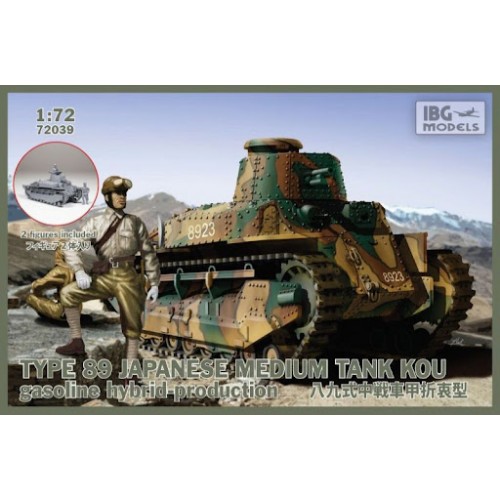
IBG 1/72
The Type 89 medium tank I-Go (八九式中戦車 イ号, Hachikyū-shiki chū-sensha I-gō) is a medium tank used by the Imperial Japanese Army from 1932 to 1942 in combat operations of the Second Sino-Japanese War, at Khalkhin Gol against the Soviet Union, and in the Second World War. The Type 89B model was the world's first mass-produced diesel engine tank. The tank was armed with a short-barrel 57 mm cannon for knocking out pillboxes and masonry fortifications, and proved effective in campaigns in Manchuria and China, as the Chinese National Revolutionary Army had only three tank battalions to oppose them, which consisted primarily of Vickers export models, German Panzer Is, and Italian CV33 tankettes. The Type 89 was a 1920s design medium tank, built to support the infantry, and thus lacked the armor or armament of 1940s generation Allied armor; it was regarded as obsolete by the time of the 1939 battles of Khalkhin Gol, against the Soviet Union. The code designation "I-Go" comes from the katakana letter [イ] for "first" and the kanji [号] for "number". The designation is also transliterated Chi-Ro and sometimes "Yi-Go".
Type 89A I-Go Kō (八九式中戦車(甲型)) - The initial production model had a water-cooled Daimler-type 100 hp (75 kW) engine (ダ式 一〇〇馬力 発動機, da-shiki hyaku-bariki hatsudōki) 6-cylinder gasoline engine and mounted a machine gun on the right side of the hull. This design could attain only 15.5 km/h, and was also limited by the severe winter climate in northern China. A total of 113 tanks were produced.
Type 89B I-Go Otsu (八九式中戦車(乙型)) - The Ko was superseded in production from 1934 by the model Otsu with an air-cooled Mitsubishi A6120VD 120 hp (89 kW) diesel engine. The improved model had a new "asymmetric shaped" gun turret complete with a cupola for the commander, and with the machine gun relocated to the left side of the hull. The multiple armor plates of the front hull were replaced by a single shallow-sloped frontal armor plate which provided more protection for the driver. However, the major difference between the versions was the Mitsubishi air-cooled 6-cylinder diesel engine, which had several advantages: lower vulnerability to fire than a gasoline engine, better fuel economy, and greater torque at lower revolutions. A diesel engine was also preferred by the Japanese Army because more diesel fuel than gasoline could be produced per barrel of oil. A total of 291 Otsu tanks were produced. The Type 89B Otsu version was the first mass-produced tank with a diesel engine.


Type 89 Japanese Medium Tank. KOU Gasoline Hybrid - Production
- Tuotemerkit IBG
- Tuotenumero: 72039
- Saatavuus: 1
-
12,00€