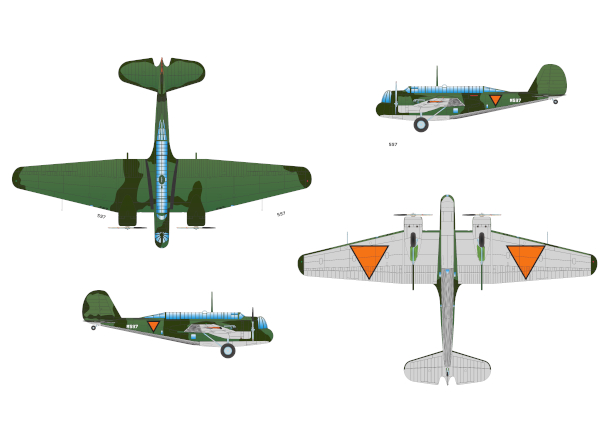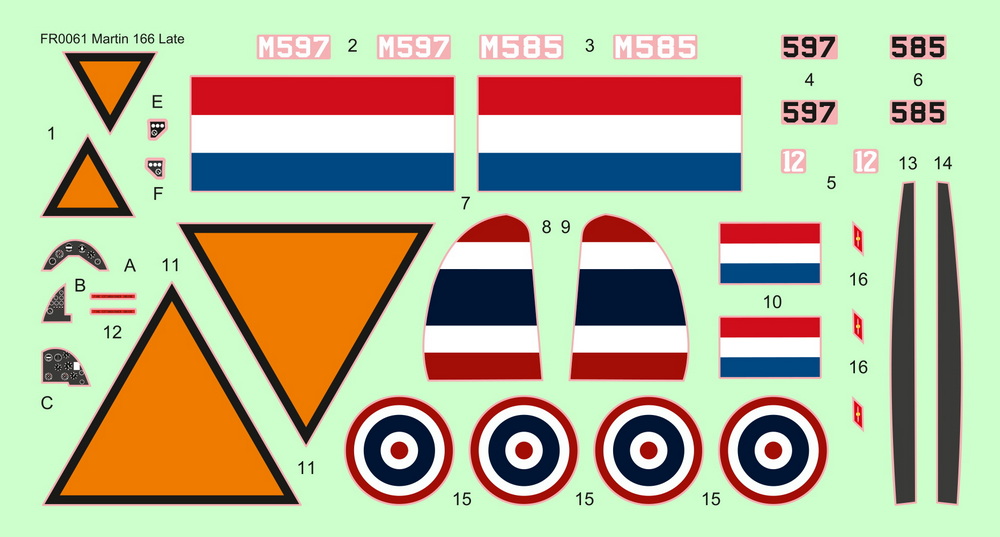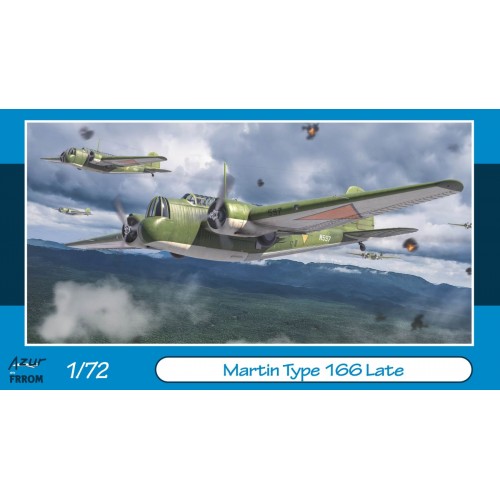
Azur-Frrom 1/72
The Martin B-10 is a bomber aircraft designed by the Glenn L. Martin Company. Entering service in June 1934, it was the first all-metal monoplane bomber to be regularly used by the United States Army Air Corps. It was also the first mass-produced bomber whose performance was superior to that of the Army's pursuit aircraft of the time.
The B-10 served as the airframe for the B-12, B-13, B-14, A-15, and O-45 designations – using Pratt & Whitney engines instead of Wright Cyclones. A total of 348 of all versions were built. The largest users were the US, with 166, and the Netherlands, with 121.
- Model 166
Final version, a.k.a. 139WH-3 and 139WH-3A, 82 built.
- Export version for the Netherlands, used in the Netherlands East Indies. Redesigned wings, nose and single 'glass house' canopy, bomb shackles between engines and fuselage, and better engines. The WH-3 had two 900 hp (670 kW) R-1820-G5 (40 built, delivered September 1938), the WH-3A had two 1,000 hp (750 kW) R-1820-G-105A (42 built, delivered March 1940). With the bomb shackles, the bomb load could be doubled for a shorter range. A total of 121 of all types were built for the Dutch