
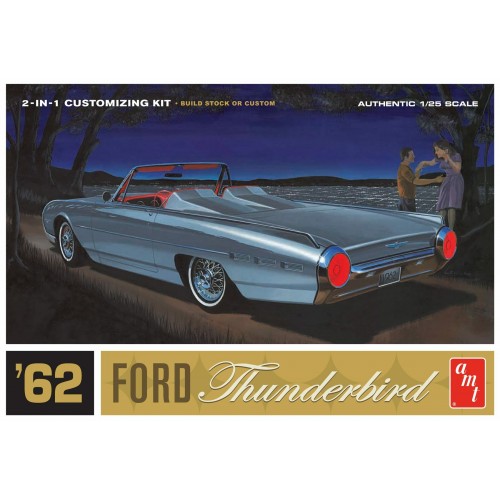
AMT 1/25
The Ford Thunderbird is a personal luxury car manufactured and marketed by Ford Motor Company for model years 1955 to 2005, with a hiatus from 1998–2001.
Ultimately gaining a broadly used colloquial nickname, the T-Bird, Ford Introduced the model as a two-seat convertible, subsequently offering it variously in a host of body styles including as a four-seat hardtop coupe, four-seat convertible, five-seat convertible and hardtop, four-door pillared hardtop sedan, six-passenger hardtop coupe, and five-passenger pillared coupe — before returning in its final generation, again as a two-seat convertible.
At it's inception, Ford targeted the two-seat Thunderbird as an upscale model. The 1958 model year design introduced a rear seat and arguably marked the expansion of a market segment that came to be known as personal luxury cars, positioned to emphasize comfort and convenience over handling and high-speed performance.
Third generation (1961–1963)
The Thunderbird was redesigned for 1961 with styling that gave the car a futuristic bullet-like body-side appearance. A new engine, the 390 cu in (6.4 L) FE V8, was the standard and only engine initially offered in the Thunderbird. It was rated at 300 hp (224 kW) and was mated to a three-speed automatic transmission. The new Thunderbird was well received, with 73,051 sold for 1961.
The car was 1961's Indianapolis 500 pace car and was featured prominently in US President John F. Kennedy's inaugural parade, who appointed Ford executive Robert McNamara as secretary of defense. It also benefitted from product placement, notably on the popular television series 77 Sunset Strip.
A vinyl-roofed Landau option with simulated S-bars was added to the Thunderbird for 1962 as was a Sports Roadster package for convertible models. The Sports Roadster included 48-spoke Kelsey-Hayes-designed wire wheels and a special fiberglass tonneau cover for the rear seats, which gave the car the appearance of a two-seat roadster like the original Thunderbird. The Sports Roadster package was slow-selling due to the high price of the package and the complexity of the tonneau cover.
Newly optional for 1962 was a 340 hp (254 kW)version of the 390 cu in (6.4 L) V8 equipped with three two-barrel Holley carburetors. For 1963 only, The engine was only available in cars equipped with factory air conditioning.
Few other changes were made to the Thunderbird for 1963, as Ford prepared to introduce a new version for 1964. A horizontal styling line was added that ran from the front of the car back through the door. Small diagonal chrome bars were added in this area on the door. Alternators rather than generators were a new feature on all 1963 Thunderbirds
