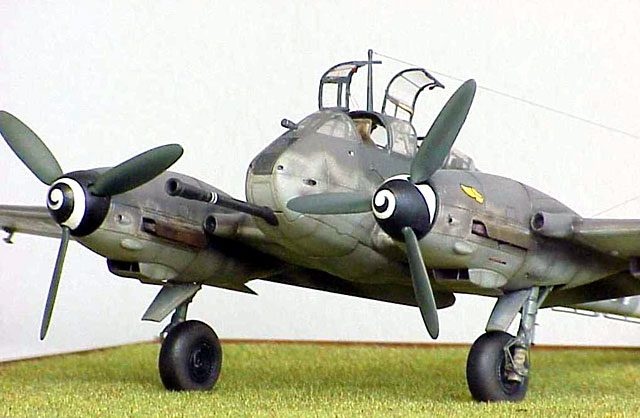
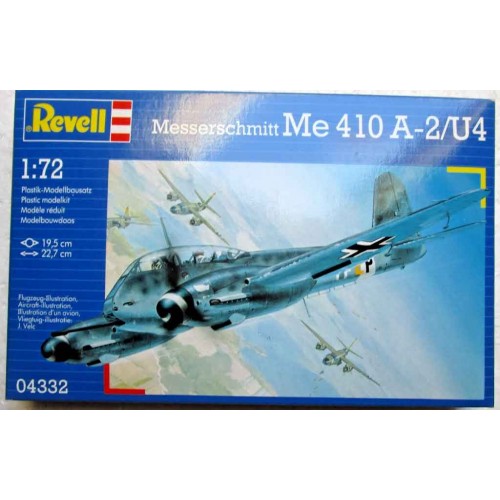
Revell 1/72
The Messerschmitt Me 410 Hornisse (Hornet) is a heavy fighter and Schnellbomber ("Fast Bomber" in English) designed and produced by the German aircraft manufacturer Messerschmitt. It was flown by the Luftwaffe during the latter half of the Second World War.
Work began on producing a successor to the Bf 110 in 1937, however, the resulting Me 210
proved to be unsatisfactory, leading to production being halted in
April 1942. Various options were considered, including the ambitious Me 310
derivative. Officials favoured an incremental improvement which was
represented by the Me 410. Although visually similar to the preceding Me
210 and sharing sufficient design similarities that incomplete Me 210s
could be converted into Me 410s, there were key differences between the
two aircraft. Chiefly, the Me 410 was powered by larger Daimler-Benz DB 603 engines, had a lengthened fuselage, and automatic leading edge slats.
A-series aircraft were armed with two 7.92 mm (.312 in) MG 17 machine guns and two 20 mm MG 151/20 cannons in the nose and delivered as the Me 410 A-1 light bomber. The Me 410 A-2 heavy fighter was cancelled because the dual 30 mm (1.18 in) MK 103 cannon mount, also available for the later Me 410 B-2 subtype as the Umrüst-Bausatz /U1 factory kit available by 1944, was not ready in time.
The Me 410 A featured a bomb bay for carrying bombs. Though by
fitting conversion kits, this could be used for other equipment.
Initially, three Umrüst-Bausätze (factory conversion kits) were available: the U1 which contained cameras for photo-reconnaissance, the U2 with two 20 mm MG 151/20 cannon with 250 rounds-per-gun for the heavy fighter. And the U4 with a 50 mm (2 in) Bordkanone, BK-5 cannon
with 22 rounds (21 rounds to load and 1 extra round in the breech). The
purpose of this was to convert either an Me 410 A or B-series aircraft
into a bomber destroyer.
The BK 5 cannon – derived from the 50 mm (2 in) KwK 39 L/60 of the Panzer III
tank – allowed Me 410s to shoot at their targets from over 914 m
(1,000 yd), a distance far greater than the range of the bombers'
defensive machine-guns. However, in practice frequent problems with
jamming, the limited ammunition supply and with the extra 540-kilogram
(1,190 lb) weight of the large-calibre gun under the nose made the other
anti-bomber versions of Me 410, especially those with extra 20 mm MG
151/20s, much more useful.