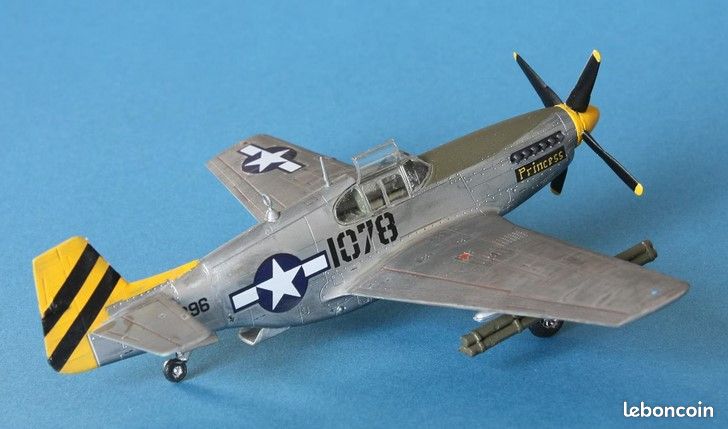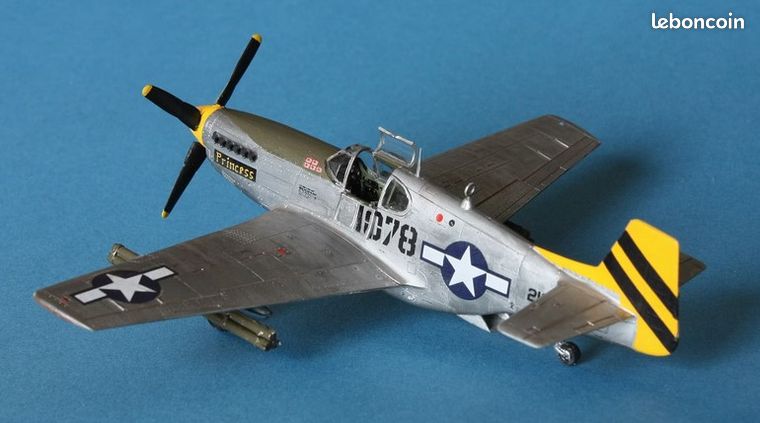
Academy 1/72
he first XP-51B flew on 30 November 1942. Flight tests confirmed the potential of the new fighter, with the service ceiling being raised by 10,000 ft (3,000 m), with the top speed improving by 50 mph (43 kn; 80 km/h) at 30,000 ft (9,100 m). American production was started in early 1943 with the P-51B (NA-102) being manufactured at Inglewood, California, and the P-51C (NA-103) at a new plant in Dallas, Texas, which was in operation by summer 1943. The RAF named these models Mustang Mk III. In performance tests, the P-51B reached 441 mph (383 kn; 710 km/h) at 30,000 ft (9,100 m). In addition, the extended range made possible by the use of drop tanks enabled the Merlin-powered Mustang to be introduced as a bomber escort with a combat radius of 750 mi (1,210 km) using two 75 US gal (62 imp gal; 280 L) 2-piece, sheet-metal stamped construction drop tanks.
The range would be further increased with the introduction of an 85 US gal (71 imp gal; 320 L) self-sealing fuel tank aft of the pilot's seat, starting with P-51B-5-NA ("block 5"). When this tank was full, the center of gravity of the Mustang was moved dangerously close to the aft limit. As a result, maneuvers were restricted until the tank was down to about 25 US gal (21 imp gal; 95 L) and the external tanks had been dropped. Problems with high-speed "porpoising" of the P-51Bs and P-51Cs with the fuselage tanks would lead to the replacement of the fabric-covered elevators with metal-covered surfaces and a reduction of the tailplane incidence. With the fuselage and wing tanks, plus two 75 US gal (62 imp gal; 280 L) drop tanks, the combat radius was 880 mi (1,420 km).