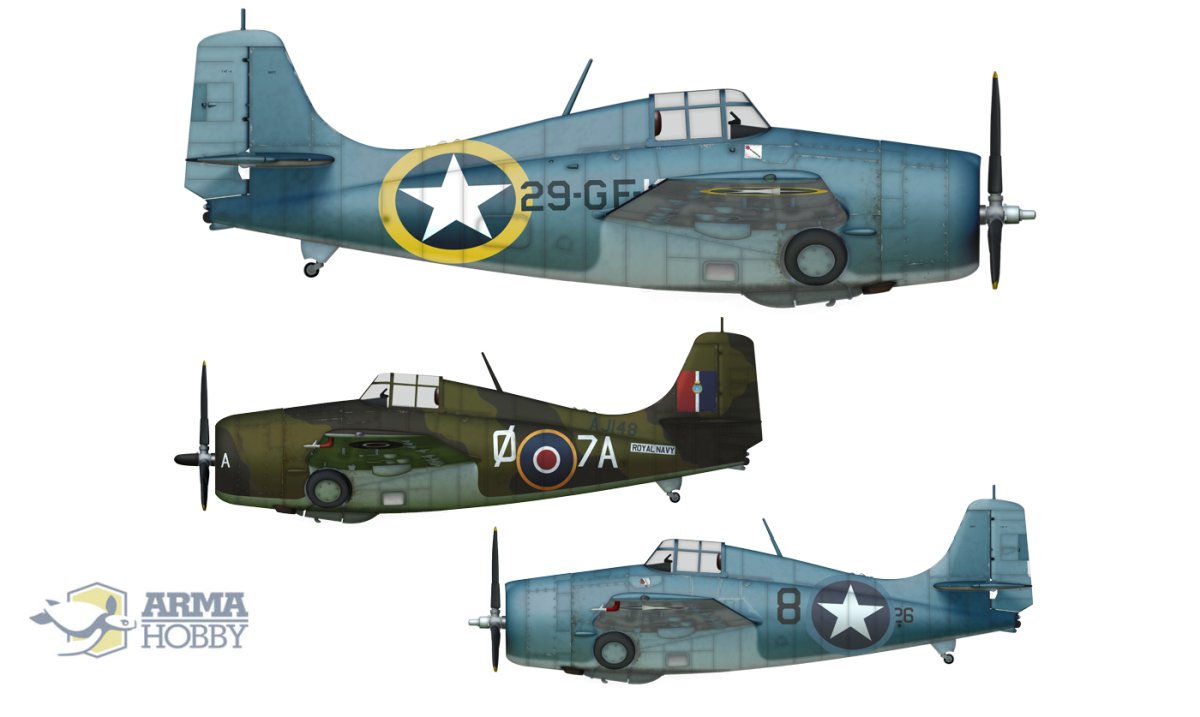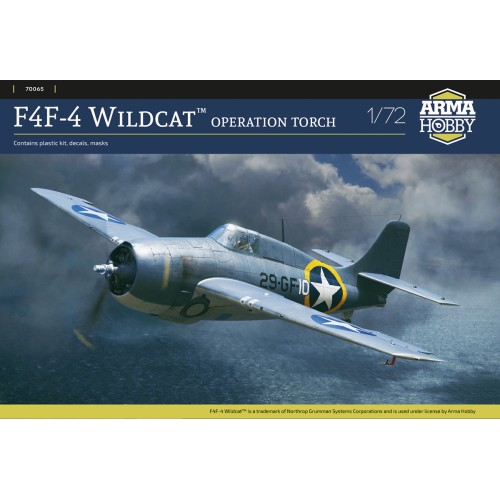
Arma Hobby 1/72.
The Grumman F4F Wildcat is an American carrier-based fighter aircraft that entered service in 1940 with the United States Navy, and the British Royal Navy where it was initially known as the Martlet. First used by the British in the North Atlantic, the Wildcat was the only effective fighter available to the United States Navy and Marine Corps in the Pacific Theater during the early part of the Second World War. The disappointing Brewster Buffalo was withdrawn in favor of the Wildcat and replaced as aircraft became available.
F4F-4
A new version, the F4F-4, entered service in 1941 with six machine guns and the Grumman-patented Sto-Wing folding wing system, which allowed more aircraft to be stored on an aircraft carrier, increasing the number of fighters that could be parked on a surface by more than a factor of 2. The F4F-4 was the definitive version that saw the most combat service in the early war years, including the Battle of Midway. Navy F4F-3s were replaced by F4F-4s in June 1942. During the Battle of Midway, only VMF-221 still used F4F-3s. VF-42 of the Yorktown was the last carrier group converted to the F4F-4, and that was done as it left Pearl Harbor on the way to the Battle of Midway as VF-3 flew in new F4F-4s with Commander Thach.
The F4F-4 version was less popular with American pilots because the same
amount of ammunition was spread over two additional guns, decreasing
firing time. With the F4F-3's four .50 in (12.7 mm) guns and 450 rpg, pilots had 34
seconds of firing time; six guns decreased ammunition to 240 rpg, which
could be expended in less than 20 seconds. The increase to six guns was
attributed to the Royal Navy, who wanted greater firepower to deal with
German and Italian foes. Jimmy Thach is quoted as saying, "A pilot who
cannot hit with four guns will miss with eight." Extra guns and folding wings meant extra weight and reduced
performance: the F4F-4 was capable of only about 318 mph (512 km/h) at
19,400 ft (5,900 m). Rate of climb was noticeably worse in the F4F-4;
while Grumman optimistically claimed the F4F-4 could climb at a modest
1,950 ft (590 m) per minute, in combat conditions, pilots found their
F4F-4s capable of ascending at only 500 to 1,000 ft (150 to 300 m) per
minute. Moreover, the F4F-4's folding wing was intended to allow five F4F-4s to
be stowed in the space required by two F4F-3s. In practice, the folding
wings allowed an increase of about 50% in the number of Wildcats
carried aboard U.S. fleet aircraft carriers. A variant of the F4F-4,
designated F4F-4B for contractual purposes, was supplied to the
British with a modified cowling and Wright Cyclone engine. These
aircraft received the designation of Martlet IV.