
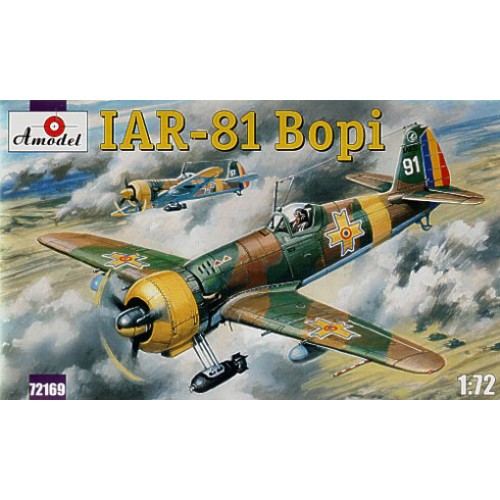
A-Model 1:72
The IAR 80 was a Romanian World War II low-wing monoplane, all-metal monocoque fighter and ground-attack aircraft. When it first flew, in 1939, it was comparable to contemporary designs being deployed by the airforces of the most advanced military powers such as the Hawker Hurricane and Bf 109E.[2] Production problems and lack of available armament delayed entry of the IAR 80 into service until 1941. It remained in frontline use until May 1945.
IAR 81
The ARR had intended to replace its light strike and dive bomber aircraft for some time when the war opened in 1941. The first role was to be filled by the IAR 37 (and later 38 and 39 models) but the plan was to fill the second role with the Junkers Ju 87. Once again the Germans deferred and the ARR was left searching for a design. The modification of the existing IAR 80 as a dive bomber was seen as a reasonable option, easier than designing an entirely new aircraft; as well as having obvious production benefits.
The result was the IAR 81, a minor change to the IAR 80A models that were then in production, adding a hinged bomb cradle under the centerline to throw a 225 kg (496 lb) bomb clear of the propeller (many dive bombers used a similar system). Delivery consisted of a shallow dive from about 3,000 to 1,000 m (9,800 to 3,300 ft) with the speed around 470 km/h (290 mph). Pilots disliked the aircraft, as the drag from the bomb cradle significantly hampered performance.
Fifty were ordered in mid-1941 but after 40 had been delivered, 50 kg (110 lb) bomb racks were added under each wing. The wing racks could also mount 100L drop tanks, allowing the 81 to be used as long-range fighters