
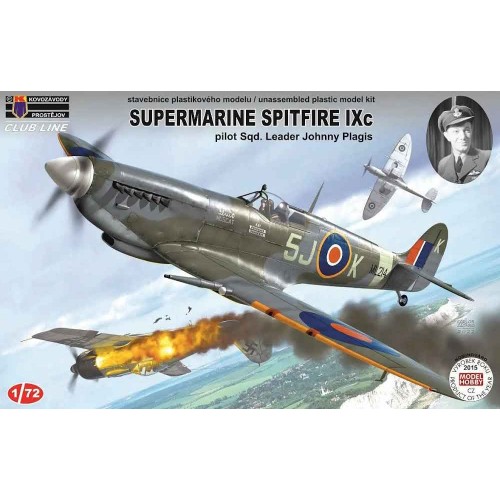
Kovozavody 1/72
The Supermarine Spitfire is a British single-seat fighter aircraft that was used by the Royal Air Force and other Allied countries before, during, and after World War II. It was the only British fighter produced continuously throughout the war. The Spitfire remains popular among enthusiasts. Around 70 remain airworthy, and many more are static exhibits in aviation museums throughout the world.
The Spitfire was a short-range, high-performance interceptor aircraft designed by R. J. Mitchell, chief designer at Supermarine Aviation Works, which operated as a subsidiary of Vickers-Armstrong from 1928. Mitchell modified the Spitfire's distinctive elliptical wing (designed by Beverley Shenstone) with innovative sunken rivets to have the thinnest possible cross-section, achieving a potential top speed greater than that of several contemporary fighter aircraft, including the Hawker Hurricane. Mitchell continued to refine the design until his death in 1937, whereupon his colleague Joseph Smith took over as chief designer.
IX
Although the Mk IX's airframe did not have the aerodynamic and strength improvements, or the modified control surfaces of the Mk VII and VIII, the Mk IX still proved to be an effective counter to the Focke-Wulf Fw 190.
In September 1942, the "High Altitude Flight" was set up at RAF Northolt to counter the threat of the high altitude Junkers Ju 86 R bombers. Two Spitfire Mk IXs converted from Vcs were stripped of armour, the .303 Brownings and other equipment and repainted in a lightweight PRU blue finish. One of them intercepted a Ju 86R at over 40,000 feet (12,000 m).
Production of the Mk IX finished at Supermarine in June 1943, with production continuing exclusively at the Castle Bromwich factory. Several major and large numbers of minor improvements were progressively introduced to Mk IXs, some of which were used on other Spitfire variants.
C type
Also known as the "universal wing" the new design was standard on the majority of Spitfires built from mid 1942. The design of the wing was altered to reduce labour and manufacturing time and carry various armaments: A type, B type, or four 20 mm Hispano cannon.
John Plagis
Ioannis Agorastos "John" Plagis, DSO, DFC & Bar (1919–1974) was a Southern Rhodesian flying ace in the Royal Air Force (RAF) during the Second World War, noted especially for his part in the defence of Malta during 1942. The son of Greek immigrants, he was accepted by recruiters only after Greece joined the Allies in late 1940. Following spells with No. 65 Squadron and No. 266 (Rhodesia) Squadron, he joined No. 249 (Gold Coast) Squadron in Malta in March 1942. Flying Spitfire Mk Vs, Plagis was part of the multinational group of Allied pilots that successfully defended the strategically important island against numerically superior Axis forces over the next few months. Flying with No. 185 Squadron from early June, he was withdrawn to England in early July 1942.
After a spell as an instructor in the UK, Plagis returned to action in September 1943 as commander of No. 64 Squadron, flying Spitfire Mk VCs over northern France. He took command of No. 126 (Persian Gulf) Squadron in June 1944, and led many attacks on German positions during the invasion of France and the campaign that followed; he was shot down over Arnhem during Operation Market Garden, but only lightly wounded. After converting to Mustang IIIs, he commanded a wing based at RAF Bentwaters that supported bombing missions. He finished the war with the rank of squadron leader and remained with the RAF afterwards, operating Gloster Meteors at the head of No. 266 (Rhodesia) Squadron.
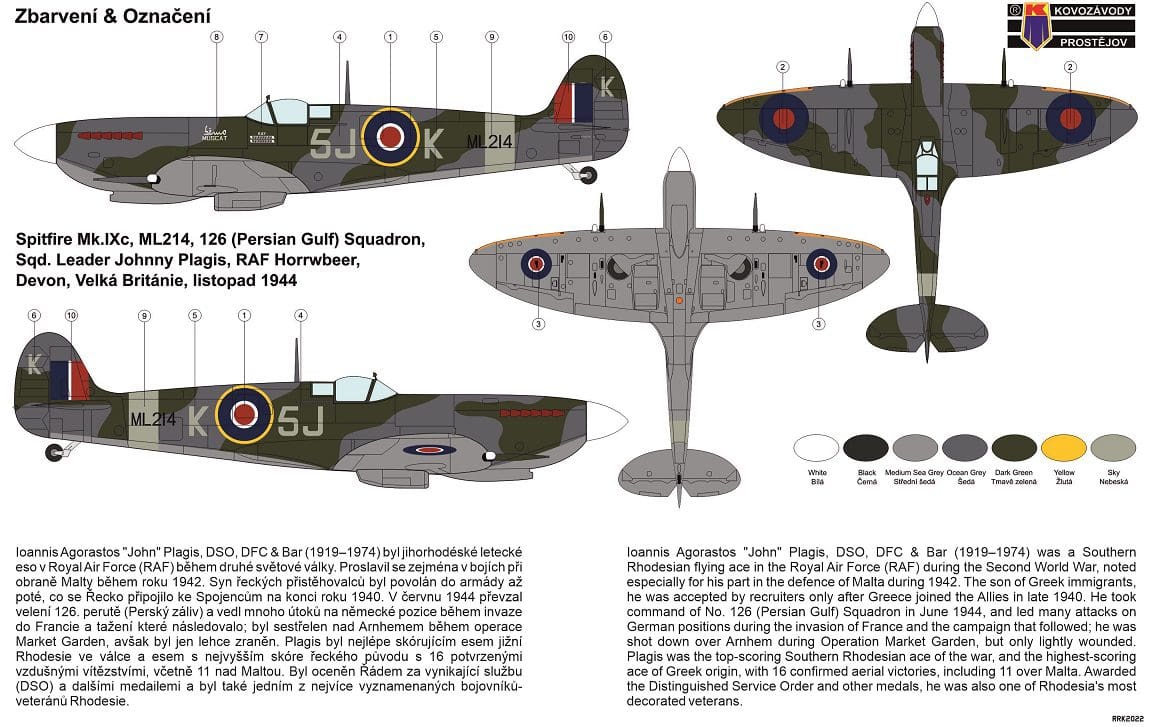
Supermarine Spitfire IXc Pilot Sqd. Leader Johnny Plagis
- Tuotemerkit Kovozavody (KP)
- Tuotenumero: CLK0006
- Saatavuus: 1
-
20,00€