
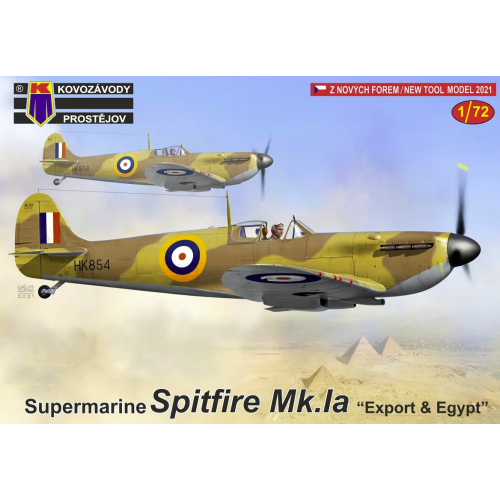
Kovozavody 1/72
The Supermarine Spitfire is a British single-seat fighter aircraft that was used by the Royal Air Force and other Allied countries before, during, and after World War II. It was the only British fighter produced continuously throughout the war. The Spitfire remains popular among enthusiasts. Around 70 remain airworthy, and many more are static exhibits in aviation museums throughout the world.
The Spitfire was a short-range, high-performance interceptor aircraft designed by R. J. Mitchell, chief designer at Supermarine Aviation Works, which operated as a subsidiary of Vickers-Armstrong from 1928. Mitchell modified the Spitfire's distinctive elliptical wing (designed by Beverley Shenstone) with innovative sunken rivets to have the thinnest possible cross-section, achieving a potential top speed greater than that of several contemporary fighter aircraft, including the Hawker Hurricane. Mitchell continued to refine the design until his death in 1937, whereupon his colleague Joseph Smith took over as chief designer.
A type
The A-type was the original wing design, with eight .303 calibre Browning machine guns, with 300 rounds per gun (rpg). The basic structure of the wing was unchanged until the C type in 1942. The one major alteration made to this wing, soon after production started, was the incorporation of a heating system for the gun bays, to prevent the guns from freezing up at high altitudes. To achieve this, open structures, such as wing ribs, surrounding the gun-bays were closed off, forming closed bays for each gun. Ducting was added, which drew heated air from the engine radiator and transferred it into the now-closed weapon-bays. Underwing vents, covered by streamlined triangular blisters just inboard of the wingtips, extracted the air, creating a negative pressure differential, and caused more heated air to be drawn in, ensuring a steady supply of heated air without any need for a mechanical blower. To keep cold air from blowing in via the muzzle openings in the leading edge, they were sealed with red fabric adhesive tape by ground crew while loading the ammunition trays. The guns fired through the tape, so they were no longer sealed after combat. Towards the end of 1940, the fabric covered ailerons were replaced by ones covered in light alloy. The A-type wing was only compatible with the 8 × .303 Browning machine gun armament suite.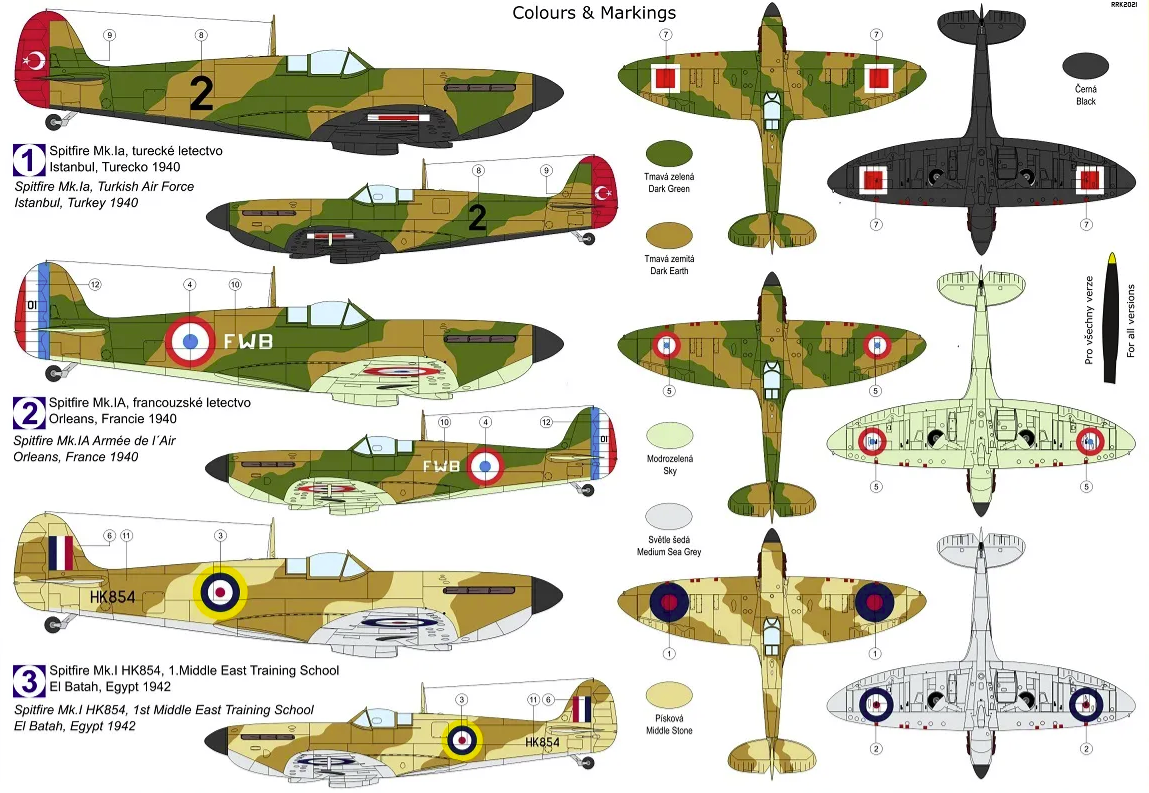
Supermarine Spitfire Mk.Ia "Export & Egypt"
- Tuotemerkit Kovozavody (KP)
- Tuotenumero: KPM277
- Saatavuus: 1
-
20,00€