
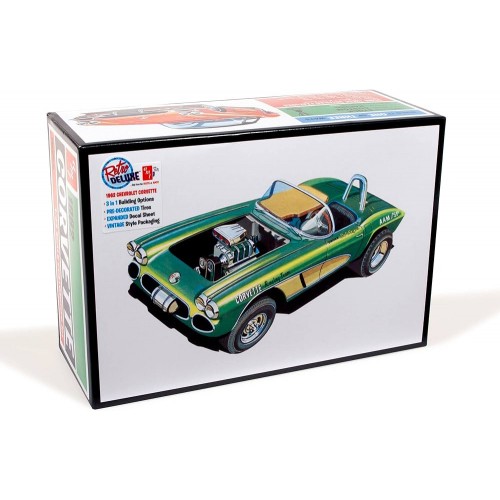
AMT 1/25
The Chevrolet Corvette (C1) is the first generation of the Corvette sports car produced by Chevrolet. It was introduced late in the 1953 model year and produced through 1962. This generation is commonly called the "solid-axle" generation, as an independent rear suspension did not appear until the 1963 Sting Ray.
The Corvette was rushed into production for its debut model year to capitalize on the enthusiastic public reaction to the concept vehicle. However, expectations for the new model were largely unfulfilled. Reviews were mixed, and sales fell far short of expectations through the car's early years. The program was nearly canceled by General Motors, but decided to make necessary improvements because Ford was developing a two-seater that became the Thunderbird
1962
With a new larger engine the 1962 model year Corvette was the quickest to date. Displacement of the small-block V8 increased from 283 cu in (4.6 L) to 327 cu in (5,360 cc), which was rated at 250 hp (186 kW) in its base single 4-barrel carburetor version. Hydraulic valve lifters were used in the standard and optional 300 hp (224 kW) engines, solid lifters in the optional carbureted 340 hp (254 kW) and fuel-injected 360 hp (268 kW) versions. Dual 4-barrel carburetor engines were no longer available.
1962 saw the last solid-rear-axle suspension, that had been used from the beginning. Rocker panel trim was seen for the first time, and exposed headlights for the last, until 2005. This was the last Corvette model to offer an optional power convertible top mechanism. Rare options: RPO 488 24-gallon fuel tank (65), RPO 687 heavy-duty brakes and steering (246), RPO 473 power convertible top (350), RPO 276 15×5.5-inch wheels (561)
